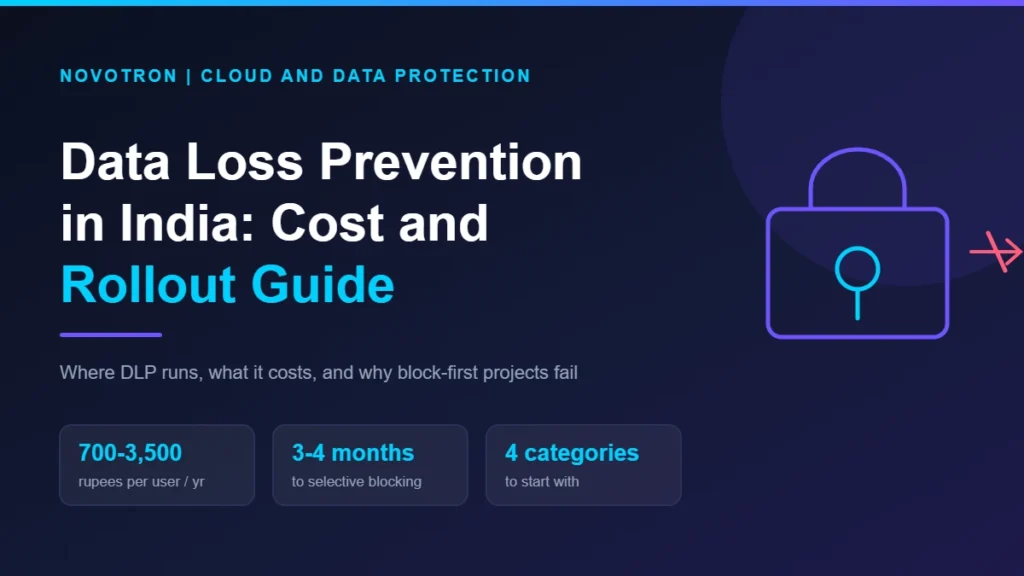
Data Loss Prevention in India (2026): Cost and Rollout Guide
What data loss prevention costs in India, where DLP runs, the five-phase rollout that actually finishes, and why block-first projects get switched off.
Cloud migration, public versus private cloud, Microsoft 365 backup, backup as a service, and the difference between disaster recovery and business continuity — explained for growing businesses.
The single most common gap we find during an assessment is a company that believes its data is backed up because it is in the cloud. It is not. Microsoft 365 replicates your mailbox; it does not protect you from an employee deleting a SharePoint library, from ransomware encrypting a synced OneDrive folder, or from a retention policy quietly ageing out a year of email. The articles in this section explain where the provider’s responsibility ends and yours begins, and what a defensible backup position actually looks like.
Beyond backup, we cover the decisions that come up in every cloud project: whether a public, private or hybrid deployment fits your workload and your compliance obligations, what a realistic migration sequence looks like for an Indian SME, how to size a recovery point objective and a recovery time objective against what an hour of downtime really costs you, and why a disaster recovery plan and a business continuity plan are two different documents that get confused constantly.
Everything here is written from delivery experience, not from vendor marketing. Novotron plans and runs cloud migrations, Microsoft 365 protection and backup-as-a-service for clients across Noida and Delhi NCR from Aycon Tower, Sector 135, Noida. Call +91-8130009878 or write to sales@novotrontech.com to discuss your environment.
What data loss prevention costs in India, where DLP runs, the five-phase rollout that actually finishes, and why block-first projects get switched off.
Microsoft 365 has become one of the world’s most widely used business productivity platforms.
Data is one of the most valuable assets for any business. Customer information, financial records, employee files, project documents, emails, applications, and databases are essential for daily operations.
Disaster recovery restores IT systems and data after an outage; business continuity keeps the whole business running during and after it. Here is how they differ, how RTO and RPO link them, and which to build first.
Cloud computing has transformed the way businesses manage technology infrastructure. Organizations today rely on cloud platforms to improve scalability, reduce costs, support remote work, and accelerate digital transformation.
As businesses expand, their technology requirements become more complex. Organizations need systems that can scale quickly, support remote teams, protect sensitive data, and adapt to changing market demands.
Businesses today are under increasing pressure to improve agility, reduce infrastructure costs, strengthen security, and support remote and hybrid work environments.