
Disaster recovery and business continuity are often used as if they mean the same thing. They don’t. Mixing them up is how companies end up with good backups but no plan for serving customers while systems are down, or with a thick continuity binder whose IT recovery steps have never been tested.
This guide explains the difference in plain terms, shows how RTO and RPO connect the two plans, and sets out the order in which to build both without paying for the same work twice.
Disaster recovery vs business continuity: the short answer
Disaster recovery (DR) is the IT-focused plan for restoring systems, applications and data after an outage, cyber attack or hardware failure. Business continuity (BC) is the wider, organisation-wide plan for keeping critical business functions running during and after the disruption, including people, premises, suppliers and customer communication. Disaster recovery is one component of business continuity, not an alternative to it.
NIST’s contingency planning guide (SP 800-34 Rev. 1) defines a business continuity plan as the documented procedures describing how an organization’s mission/business processes will be sustained during and after a significant disruption. It defines a disaster recovery plan as a written plan for recovering one or more information systems at an alternate facility in response to a major hardware or software failure or destruction of facilities.
| Disaster recovery (DR) | Business continuity (BC) | |
|---|---|---|
| Question it answers | How do we get our IT systems and data back? | How does the business keep serving customers while they are down? |
| Scope | Servers, applications, databases, networks, cloud workloads, backups | People, processes, premises, suppliers, communication and IT together |
| When it runs | After an outage or incident, until systems are restored | Before, during and after the disruption |
| Owned by | IT / infrastructure team | Business leadership, with every department |
| Key metrics | RTO and RPO for each system | Maximum tolerable downtime per business process |
| Main document | Disaster recovery plan (DRP) | Business continuity plan (BCP) |
| Reference standard | NIST SP 800-34 Rev. 1 (contingency planning) | ISO 22301:2019 (business continuity management systems) |
What is disaster recovery?
Disaster recovery covers the technical steps that bring IT services back: restoring from backups, failing over to a secondary site or cloud region, rebuilding servers and identity systems, and checking that data is complete and clean. A disaster recovery plan lists every critical system, its recovery priority, where its backups live, who restores it and in what order.
For most Indian SMEs, the most likely “disaster” is not a flood or fire. It is ransomware, a failed server or storage array, an accidental deletion in Microsoft 365, or a misconfigured cloud change. A DR plan has to handle all of these, not only the loss of a building.
What is business continuity?
Business continuity asks a different question: if the ERP, email or office is unavailable for two days, how do sales, finance, support and operations keep working? The answer usually mixes manual workarounds, alternate sites or remote work, pre-agreed supplier arrangements, and a communication plan for staff, customers and regulators.
ISO 22301:2019 is the international standard for a business continuity management system (BCMS). Organisations that want a certifiable programme usually align their BCP with it.
How RTO and RPO connect the two plans
Two numbers turn a continuity requirement into an IT recovery target:
- Recovery Time Objective (RTO): NIST defines it as the overall length of time a system’s components can be in the recovery phase before negatively impacting the organisation’s business processes. In practice: how long a system can stay down.
- Recovery Point Objective (RPO): the point in time to which data must be recovered after an outage. In practice: how much recent data you can afford to lose.
The business continuity side sets the tolerance (“billing cannot stop for more than four hours”). The disaster recovery side designs backups, replication and failover to meet it (“the billing database gets a four-hour RTO and a fifteen-minute RPO”). If the RTO and RPO are set by IT alone, without a business impact analysis, they are guesses.
Worked example
Illustrative example, not a client case study. A 60-person distributor in Noida runs its ERP on a single on-premise server with nightly backups. The business impact analysis shows that order-taking can run on phone and spreadsheets for one working day, but invoicing and GST filings cannot slip beyond that. So:
- BC decision: maximum tolerable downtime for invoicing is one working day. Sales teams keep a manual order template and a customer contact export.
- DR decision: the ERP gets an RTO of 8 hours and an RPO of 1 hour. Nightly backups alone cannot meet a 1-hour RPO, so the plan adds hourly snapshots replicated off-site, plus a tested restore procedure to a standby server or cloud VM.
- Test: a restore drill every quarter, with the actual time taken recorded against the 8-hour target.
Which should you build first?
Build them in this order, so each step feeds the next and nothing is done twice:
- Business impact analysis (BIA): list critical processes, their dependencies and how long each can be down.
- Business continuity strategy: decide the workaround for each critical process and set maximum tolerable downtime.
- Disaster recovery design: translate those limits into RTO and RPO per system, then choose backup, replication and failover to match.
- Document and assign owners: one BCP, one DRP, with the DRP referenced from the BCP rather than copied into it.
- Test: tabletop exercises for the BCP, and technical restore tests for the DRP.
If budget allows only one project this quarter, start with tested, isolated backups for your most critical systems. Without recoverable data, no continuity plan works. Then run the BIA before spending on replication or secondary sites, so you don’t overbuild recovery for systems the business can live without for a few days.
Indian organisations should also factor in incident-reporting duties. CERT-In directions require certain cyber incidents to be reported within six hours of being noticed, so the continuity plan’s communication tree needs a named person for that. See our CERT-In compliance guide for details.
Benefits of disaster recovery and business continuity
Organizations that invest in both Disaster Recovery (DR) and Business Continuity (BC) gain far more than protection against unexpected incidents. They create a resilient business that can adapt quickly, maintain customer confidence, and continue operations even during challenging situations.
Below are some of the key benefits.
1. Reduced Business Downtime
Every minute of downtime can affect productivity, customer satisfaction, and revenue.
A well-defined Disaster Recovery strategy enables businesses to restore critical systems quickly, while a Business Continuity Plan ensures employees continue performing essential tasks during the recovery process.
This combination minimizes operational disruptions and keeps the business moving forward.
2. Better Protection Against Cyber Attacks
Cyber threats such as ransomware, phishing, insider attacks, and malware continue to evolve.
If an attack successfully compromises business systems, organizations with Disaster Recovery capabilities can restore clean backups and recover affected infrastructure.
At the same time, Business Continuity procedures help maintain customer support, internal communication, and essential business operations until systems are fully restored.
3. Improved Customer Trust
Customers expect businesses to remain available and responsive.
Organizations that recover quickly from disruptions demonstrate professionalism, reliability, and preparedness.
Maintaining service availability during unexpected incidents strengthens customer confidence and protects long-term relationships.
4. Faster Recovery After Unexpected Events
Whether the disruption is caused by hardware failure, human error, software corruption, or natural disasters, having documented recovery procedures significantly reduces recovery time.
Instead of making decisions during a crisis, teams follow predefined recovery processes that have already been tested.
This improves both speed and accuracy.
5. Regulatory Compliance
Many industries require organizations to maintain business continuity and disaster recovery capabilities.
Examples include:
- Financial Services
- Healthcare
- Manufacturing
- Government Organizations
- Critical Infrastructure Providers
A documented recovery and continuity strategy helps organizations meet compliance requirements while improving operational resilience.
6. Reduced Financial Losses
Business interruptions often result in:
- Lost sales
- Delayed projects
- Missed customer commitments
- Emergency recovery expenses
- Productivity losses
By reducing downtime and accelerating recovery, businesses can significantly reduce the financial impact of unexpected disruptions.
Common Risks That Disaster Recovery and Business Continuity Address
Modern organizations face numerous operational and cyber security risks.
A comprehensive resilience strategy helps prepare for events such as:
Cyber Security Incidents
- Ransomware attacks
- Malware infections
- Credential theft
- Insider threats
Infrastructure Failures
- Server crashes
- Storage failures
- Network outages
- Hardware failures
Cloud Service Disruptions
Although cloud providers offer high availability, outages can still occur.
Business Continuity planning helps organizations continue operations while cloud services are restored.
Human Errors
Employees may accidentally delete files, misconfigure systems, or expose sensitive information.
Recovery plans reduce the impact of these mistakes.
Natural Disasters
Floods, earthquakes, fires, storms, and other environmental events can disrupt office operations.
Business Continuity planning helps organizations continue operating through remote work, alternative facilities, and cloud-based collaboration.
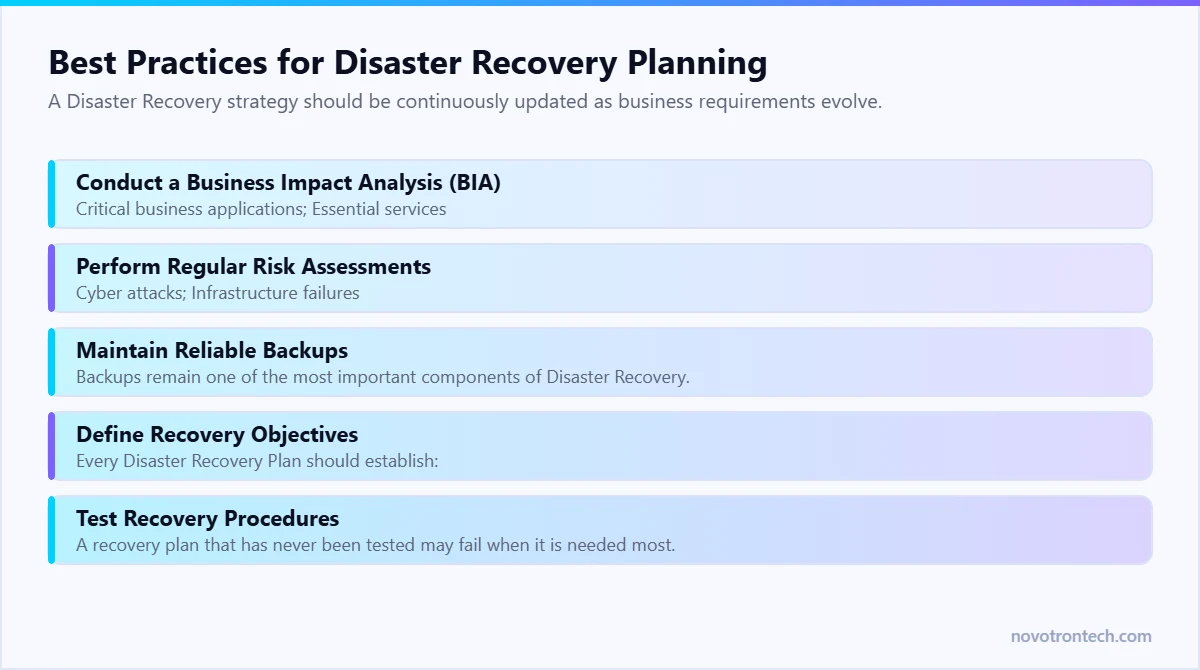
Best Practices for Disaster Recovery Planning
A Disaster Recovery strategy should be continuously updated as business requirements evolve.
Organizations should follow these best practices.
Conduct a Business Impact Analysis (BIA)
A Business Impact Analysis identifies:
- Critical business applications
- Essential services
- Recovery priorities
- Maximum acceptable downtime
Understanding business priorities helps organizations allocate recovery resources effectively.
Perform Regular Risk Assessments
Businesses should regularly identify risks that may affect operations, including:
- Cyber attacks
- Infrastructure failures
- Third-party dependencies
- Cloud risks
- Human errors
Proactive risk assessments improve preparedness.
Maintain Reliable Backups
Backups remain one of the most important components of Disaster Recovery.
Businesses should:
- Automate backup schedules
- Encrypt backup data
- Store backups securely
- Maintain off-site or cloud copies
- Test backup restoration regularly
Reliable backups significantly reduce recovery time after incidents.
Define Recovery Objectives
Every Disaster Recovery Plan should establish:
Recovery Time Objective (RTO)
How quickly systems must be restored.
Recovery Point Objective (RPO)
The acceptable amount of data loss after an incident.
Clearly defined objectives guide recovery decisions during emergencies.
Test Recovery Procedures
A recovery plan that has never been tested may fail when it is needed most.
Organizations should conduct periodic Disaster Recovery exercises to verify:
- Backup integrity
- Recovery speed
- Team readiness
- Communication processes
Regular testing improves confidence and preparedness.
Best Practices for Business Continuity Planning
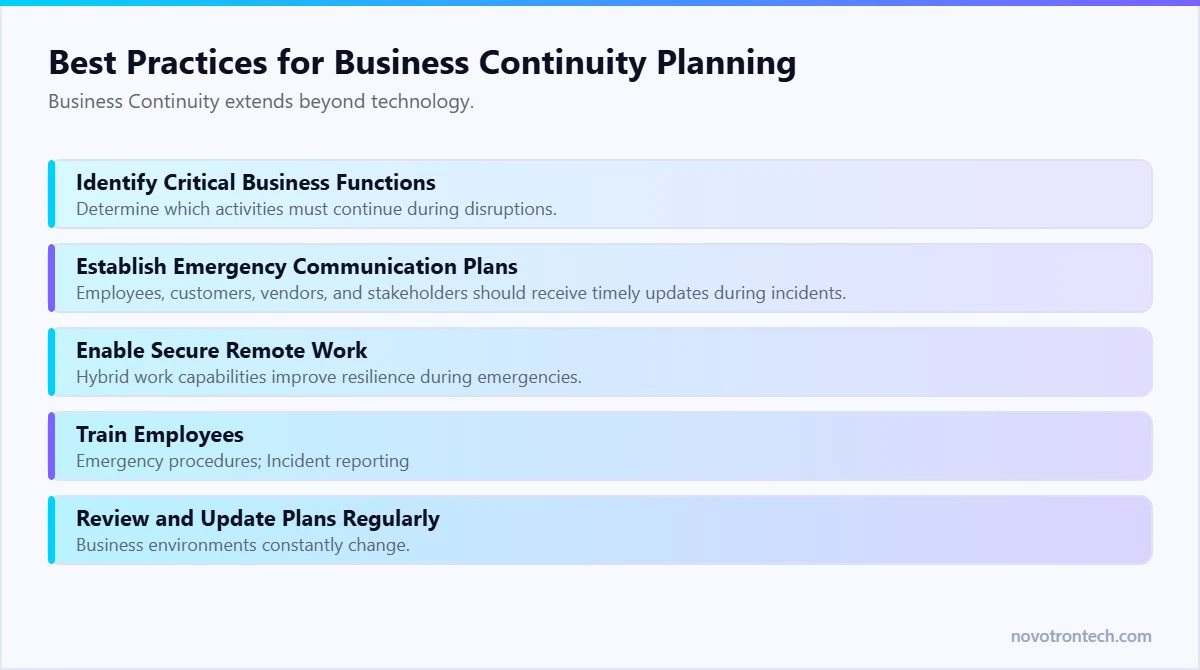
Business Continuity extends beyond technology.
Organizations should also prepare people, communication channels, and operational processes.
Identify Critical Business Functions
Determine which activities must continue during disruptions.
Examples include:
- Customer support
- Financial operations
- Order processing
- Communication systems
- Production activities
Establish Emergency Communication Plans
Employees, customers, vendors, and stakeholders should receive timely updates during incidents.
Communication plans should define:
- Notification methods
- Responsibilities
- Escalation procedures
- Emergency contacts
Enable Secure Remote Work
Hybrid work capabilities improve resilience during emergencies.
Businesses should implement:
- Secure VPN access
- Multi-Factor Authentication (MFA)
- Cloud collaboration platforms
- Endpoint security
Remote work allows essential operations to continue even when office access is unavailable.
Train Employees
Employees should understand:
- Emergency procedures
- Incident reporting
- Communication protocols
- Cyber security awareness
- Business Continuity responsibilities
Regular training improves organizational readiness.
Review and Update Plans Regularly
Business environments constantly change.
Organizations should review continuity plans after:
- Technology upgrades
- Organizational restructuring
- New compliance requirements
- Major security incidents
Continuous improvement keeps plans effective.
How Cloud Computing Strengthens Disaster Recovery
Cloud technology has transformed Disaster Recovery strategies.
Traditional recovery often required expensive secondary data centers and complex hardware replication.
Modern cloud platforms provide:
- Automated backups
- Geographic redundancy
- High availability
- Rapid workload recovery
- Scalable infrastructure
- Cost-effective disaster recovery solutions
Cloud-based Disaster Recovery enables businesses to recover systems faster while reducing infrastructure costs.
Common Mistakes Businesses Make
Despite understanding the importance of resilience, many organizations make avoidable mistakes.
Assuming Backups Alone Are Enough
Backups are important but do not replace Business Continuity planning.
Never Testing Recovery Plans
Untested recovery procedures often fail during real emergencies.
Ignoring Employee Training
Technology alone cannot ensure successful recovery.
Employees must understand their responsibilities during incidents.
Failing to Protect Cloud Workloads
Cloud environments also require backup, monitoring, and recovery planning.
Outdated Documentation
Recovery procedures should reflect the current IT environment.
Outdated documentation increases confusion during emergencies.
Why Businesses Choose Novotron for Disaster Recovery and Business Continuity
Building a resilient organization requires more than simply maintaining backups.
Businesses need an experienced technology partner that understands infrastructure, cyber security, cloud platforms, and operational resilience.
Novotron helps organizations strengthen business resilience through:
- Disaster Recovery Planning
- Business Continuity Strategy Development
- Cloud Backup Solutions
- IT Infrastructure Management
- Security Operations Center (SOC) Support
- Vulnerability Assessment & Penetration Testing (VAPT)
- Network Security Services
- Endpoint Security Solutions
- Cloud Migration & Cloud Infrastructure Services
- 24×7 Infrastructure Monitoring
By combining proactive monitoring, cloud technologies, and cyber security expertise, Novotron helps businesses minimize downtime, recover faster, and maintain operational continuity during unexpected events.
Conclusion
Unexpected disruptions are no longer a question of if but when. Cyber attacks, hardware failures, software issues, cloud outages, and natural disasters can affect businesses of any size. Organizations that prepare in advance recover faster, reduce financial losses, and maintain customer trust.
Although Disaster Recovery and Business Continuity are closely related, they solve different challenges. Disaster Recovery focuses on restoring IT systems, applications, and data after an incident, while Business Continuity ensures that critical business operations continue throughout the disruption.
A comprehensive resilience strategy combines both approaches with proactive cyber security, continuous monitoring, cloud technologies, and employee preparedness. Together, these elements help organizations minimize downtime, improve operational stability, and remain competitive in an increasingly digital world.
Whether your business is modernizing its IT infrastructure, migrating to the cloud, or strengthening its cyber security posture, investing in Disaster Recovery and Business Continuity planning is essential for long-term success.
Partnering with an experienced technology provider like Novotron enables organizations to build resilient IT environments that are prepared for today’s evolving threat landscape while supporting future growth.
Frequently Asked Questions (FAQs)
What is the difference between Disaster Recovery and Business Continuity?
Disaster Recovery focuses on restoring IT systems, applications, and data after a disruption. Business Continuity focuses on ensuring that critical business operations continue before, during, and after the incident.
Why are Disaster Recovery and Business Continuity important?
They help organizations reduce downtime, recover quickly from cyber attacks or system failures, protect customer trust, maintain regulatory compliance, and minimize financial losses.
What should a Disaster Recovery Plan include?
A Disaster Recovery Plan should include:
- Backup and recovery procedures
- Recovery Time Objectives (RTO)
- Recovery Point Objectives (RPO)
- Infrastructure recovery processes
- Roles and responsibilities
- Disaster Recovery testing procedures
What should a Business Continuity Plan include?
A Business Continuity Plan typically includes:
- Critical business processes
- Employee communication plans
- Emergency response procedures
- Remote work strategies
- Supplier and customer communication
- Crisis management processes
- Operational continuity planning
How often should Disaster Recovery and Business Continuity plans be tested?
Businesses should review and test their plans at least annually or whenever significant changes occur in infrastructure, business operations, or compliance requirements. Regular testing helps identify gaps and improves overall preparedness.
Can cloud computing improve Disaster Recovery?
Yes. Cloud-based Disaster Recovery solutions provide automated backups, geographic redundancy, faster recovery times, and scalable infrastructure, making disaster recovery more efficient and cost-effective.
Are Disaster Recovery and Business Continuity only for large enterprises?
No. Businesses of all sizes can benefit from these strategies. Small and medium-sized organizations are often more vulnerable to operational disruptions because they typically have fewer resources to recover from major incidents.
Related: the complete cloud migration guide · our cloud solutions · managed IT services in Noida.
Sources
- NIST SP 800-34 Rev. 1, Contingency Planning Guide for Federal Information Systems, and the NIST CSRC glossary entries for RTO, RPO, business continuity plan and disaster recovery plan.
- ISO 22301:2019, Security and resilience: Business continuity management systems, Requirements.
- CERT-In, Indian Computer Emergency Response Team, directions on cyber incident reporting.