As businesses expand, their technology requirements become more complex. Organizations need systems that can scale quickly, support remote teams, protect sensitive data, and adapt to changing market demands.
Traditional on-premises infrastructure often struggles to meet these expectations. High maintenance costs, limited scalability, and infrastructure constraints can slow growth and reduce operational efficiency.
Cloud solutions address these challenges by providing businesses with flexible, secure, and scalable technology environments.
In 2026, cloud adoption is no longer limited to large enterprises. Startups, small businesses, and growing organizations are increasingly using cloud technologies to improve agility, reduce costs, and accelerate innovation.
Understanding the benefits of cloud solutions can help businesses make informed technology decisions and build a stronger foundation for future growth.
What Are Cloud Solutions?
Cloud solutions refer to technology services delivered over the internet instead of through on-premises infrastructure.
These services allow businesses to access computing resources such as:
- Servers
- Storage
- Databases
- Applications
- Networking
- Security tools
- Analytics platforms
Cloud environments provide on-demand access to resources, enabling organizations to scale operations without investing heavily in physical infrastructure.
Common cloud models include:
- Public Cloud
- Private Cloud
- Hybrid Cloud
Each model offers different levels of flexibility, control, and security.
Why Growing Businesses Are Adopting Cloud Solutions
Businesses today need technology that can evolve alongside changing customer expectations and operational requirements.
Cloud solutions help organizations:
- Adapt quickly to market changes
- Support remote and hybrid work models
- Improve collaboration
- Increase operational efficiency
- Reduce infrastructure complexity
As digital transformation accelerates, cloud technologies have become essential for sustainable business growth.
1. Improved Scalability
One of the biggest advantages of cloud solutions is scalability.
Businesses can increase or decrease resources based on demand without purchasing additional hardware.
This flexibility helps organizations:
- Support seasonal demand
- Handle business growth
- Launch new services quickly
- Expand into new markets
Scalable infrastructure ensures businesses only pay for the resources they use.
2. Reduced Infrastructure Costs
Traditional IT environments often require significant investments in:
- Hardware
- Maintenance
- Upgrades
- Data centers
- Energy consumption
Cloud solutions operate on a pay-as-you-go model, reducing capital expenditure and improving cost predictability.
Organizations can optimize spending while maintaining access to enterprise-grade technology.
3. Enhanced Business Agility
Cloud platforms enable businesses to deploy new applications and services faster.
This allows organizations to:
- Respond quickly to customer needs
- Accelerate product development
- Improve time-to-market
- Support innovation initiatives
Greater agility creates a competitive advantage in rapidly changing industries.
4. Better Collaboration and Remote Work Support
Modern workplaces require seamless collaboration across teams and locations.
Cloud solutions enable employees to securely access applications and data from anywhere.
Benefits include:
- Real-time collaboration
- Improved communication
- Flexible work environments
- Increased productivity
Cloud technologies support hybrid and remote work models effectively.
5. Stronger Business Continuity
Unexpected disruptions can significantly impact operations.
Cloud environments help businesses maintain continuity through:
- Automated backups
- Disaster recovery capabilities
- Data redundancy
- High availability
These features reduce downtime and improve resilience during unexpected events.
6. Enhanced Security Features
Leading cloud providers invest heavily in security technologies.
Cloud environments often include:
- Data encryption
- Multi-factor authentication
- Identity and access management
- Threat monitoring
- Continuous security updates
When implemented correctly, cloud solutions can strengthen an organization’s security posture.
However, businesses should still follow security best practices and regularly assess cloud environments.
7. Improved Performance and Reliability
Cloud providers operate global infrastructure designed for high performance and availability.
Businesses benefit from:
- Faster application performance
- Reduced latency
- Reliable uptime
- Optimized resource allocation
Reliable technology environments improve customer experiences and employee productivity.
8. Access to Advanced Technologies
Cloud platforms provide access to technologies that may be difficult or expensive to implement internally.
These include:
- Artificial Intelligence
- Machine Learning
- Data Analytics
- Automation Tools
- Internet of Things (IoT)
Businesses can innovate more efficiently without managing complex infrastructure.
9. Simplified IT Management
Cloud solutions reduce the burden of managing physical infrastructure.
IT teams can focus on strategic initiatives rather than routine maintenance tasks.
Managed cloud services help businesses:
- Monitor environments proactively
- Optimize performance
- Improve security
- Control costs
Simplified management increases operational efficiency.
10. Supports Digital Transformation
Cloud technologies provide the foundation for digital transformation initiatives.
Organizations can modernize operations by:
- Automating workflows
- Improving customer experiences
- Integrating business applications
- Enabling data-driven decision-making
Cloud adoption helps businesses remain competitive in a digital-first economy.
Common Cloud Deployment Models
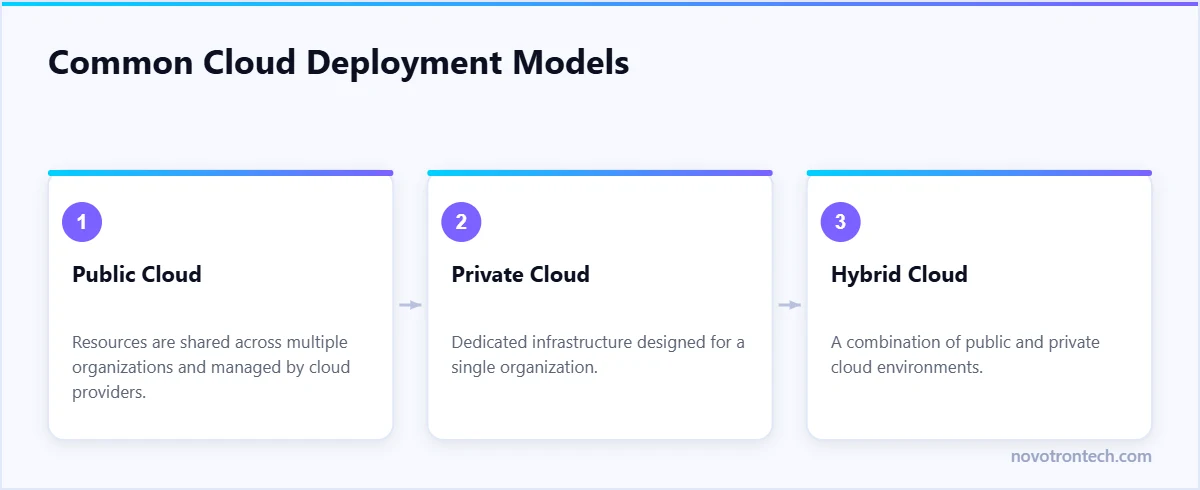
Public Cloud
Resources are shared across multiple organizations and managed by cloud providers.
Private Cloud
Dedicated infrastructure designed for a single organization.
Hybrid Cloud
A combination of public and private cloud environments.
The right deployment model depends on business goals, security requirements, and compliance needs.
Which Businesses Benefit Most from Cloud Solutions?
Cloud solutions support organizations of all sizes and industries.
Common sectors include:
- Healthcare
- Financial Services
- Retail
- Manufacturing
- Education
- Technology
- Logistics
- E-commerce
Any organization seeking flexibility, scalability, and efficiency can benefit from cloud adoption.
How to Choose the Right Cloud Solutions Partner
Businesses should evaluate providers based on:
- Technical expertise
- Security capabilities
- Industry experience
- Cloud migration support
- Ongoing management services
- Scalability
An experienced partner can help organizations maximize cloud investments while reducing risk.
Why Businesses Choose Novotron for Cloud Solutions
Successful cloud adoption requires more than technology implementation.
Businesses need strategic guidance and ongoing support.
Novotron helps organizations:
- Assess cloud readiness
- Develop migration strategies
- Optimize cloud environments
- Strengthen cloud security
- Manage cloud infrastructure
By aligning technology decisions with business goals, Novotron enables organizations to achieve long-term success through cloud transformation.
Where the Savings Come From — and Where They Do Not
Cloud is often sold as cheaper. It is more accurate to say the cost moves and becomes visible. Capital spend on hardware every four or five years becomes a monthly operating cost you can see, attribute and adjust.
- Genuine savings. No hardware refresh cycle, no data centre power and cooling, no over-provisioning for a peak that happens twice a year, and no idle spend on disaster recovery hardware that sits waiting.
- Neutral. Steady-state workloads that run at constant load around the clock. These often cost about the same, with the benefit showing up in resilience and management rather than the invoice.
- More expensive if unmanaged. Oversized instances migrated as-is, orphaned storage and snapshots, per-GB data transfer between regions, and every environment left running overnight and at weekends.
The businesses that see savings are the ones that right-size after migration and apply reserved or savings-plan pricing to predictable workloads. Without that discipline, cloud is simply someone else’s hardware at a premium. The sequencing is covered in our cloud migration guide.
The Shared Responsibility Model, in Plain Terms
This is the single most misunderstood part of moving to cloud. The provider secures the platform. You secure everything you put on it.
- The provider handles physical security, host infrastructure, hypervisor patching and the availability of the managed services you consume.
- You handle identity and access, network configuration, operating system and application patching on your instances, data classification and encryption choices, and backup of your own data.
- Both matter for compliance. A provider’s certifications cover their layer. Your DPDP obligations for personal data remain yours regardless of where it is hosted — see the DPDP compliance checklist.
The practical consequence: a misconfigured storage bucket, an over-permissive role or an unpatched VM is your incident, not the provider’s. This is why identity and access management matters more in cloud than it did on-premise.
Data Residency and Indian Regulation
All major providers now operate Indian regions, which removes the residency objection for most workloads. Two points still need a decision rather than an assumption: which region your data actually sits in by default, and where backups and replicas land. Cross-region replication configured for resilience can quietly move personal data outside the country. Confirm both in writing before the first production workload goes live.
When Cloud Is the Wrong Answer
- Latency-sensitive systems tied to on-site equipment — plant floor controllers, laboratory instruments, some CAD workflows.
- Applications with licensing that penalises virtualised or per-core cloud deployment.
- Large, stable, predictable workloads already running on hardware with years of life left and no refresh due.
- Environments with no capacity to manage cloud governance, where a hybrid arrangement with a managed provider is the safer step. Public cloud vs private cloud works through the trade-off.
Conclusion
Cloud solutions have become essential for businesses seeking greater flexibility, efficiency, and resilience.
By improving scalability, reducing costs, supporting remote work, enhancing security, and enabling innovation, cloud technologies help organizations build a strong foundation for growth.
As digital transformation continues to accelerate, businesses that embrace cloud solutions will be better positioned to adapt, compete, and succeed.
FAQs
What are cloud solutions?
Cloud solutions provide access to computing resources such as servers, storage, applications, and databases over the internet.
How do cloud solutions benefit businesses?
Cloud solutions improve scalability, reduce costs, enhance security, support collaboration, and strengthen business continuity.
Are cloud solutions secure?
Yes. Leading cloud providers offer advanced security features, including encryption, identity management, and continuous monitoring.
What types of cloud solutions are available?
The main cloud deployment models are public cloud, private cloud, and hybrid cloud.
Can small businesses benefit from cloud solutions?
Yes. Cloud technologies provide cost-effective access to enterprise-grade infrastructure and services for businesses of all sizes.
Related: the complete cloud migration guide · our cloud solutions · managed IT services in Noida.