Cloud computing has transformed the way businesses manage technology infrastructure. Organizations today rely on cloud platforms to improve scalability, reduce costs, support remote work, and accelerate digital transformation.
However, one of the most common questions businesses face is whether to choose a Public Cloud or a Private Cloud environment.
Both deployment models offer unique advantages, and selecting the right option depends on factors such as security requirements, budget, compliance obligations, performance expectations, and business goals.
Understanding the differences between Public Cloud and Private Cloud can help organizations make smarter technology investments and build a cloud strategy that supports long-term growth.
What Is Public Cloud?
A Public Cloud is a cloud computing environment where infrastructure and services are provided by a third-party cloud provider and shared among multiple customers.
Businesses access resources such as:
- Computing power
- Storage
- Databases
- Applications
- Networking services
through the internet on a subscription or pay-as-you-go basis.
Popular public cloud platforms include:
- Amazon Web Services (AWS)
- Microsoft Azure
- Google Cloud
Public cloud providers manage the infrastructure, maintenance, and updates, allowing businesses to focus on operations and innovation.
What Is Private Cloud?
A Private Cloud is a cloud environment dedicated exclusively to a single organization.
Unlike public cloud environments, private cloud resources are not shared with other businesses.
Private cloud infrastructure can be:
- Hosted on-premises
- Hosted in a private data center
- Managed by a third-party provider
Private cloud environments provide greater control, customization, and security.
Organizations with strict compliance and data governance requirements often choose private cloud solutions.
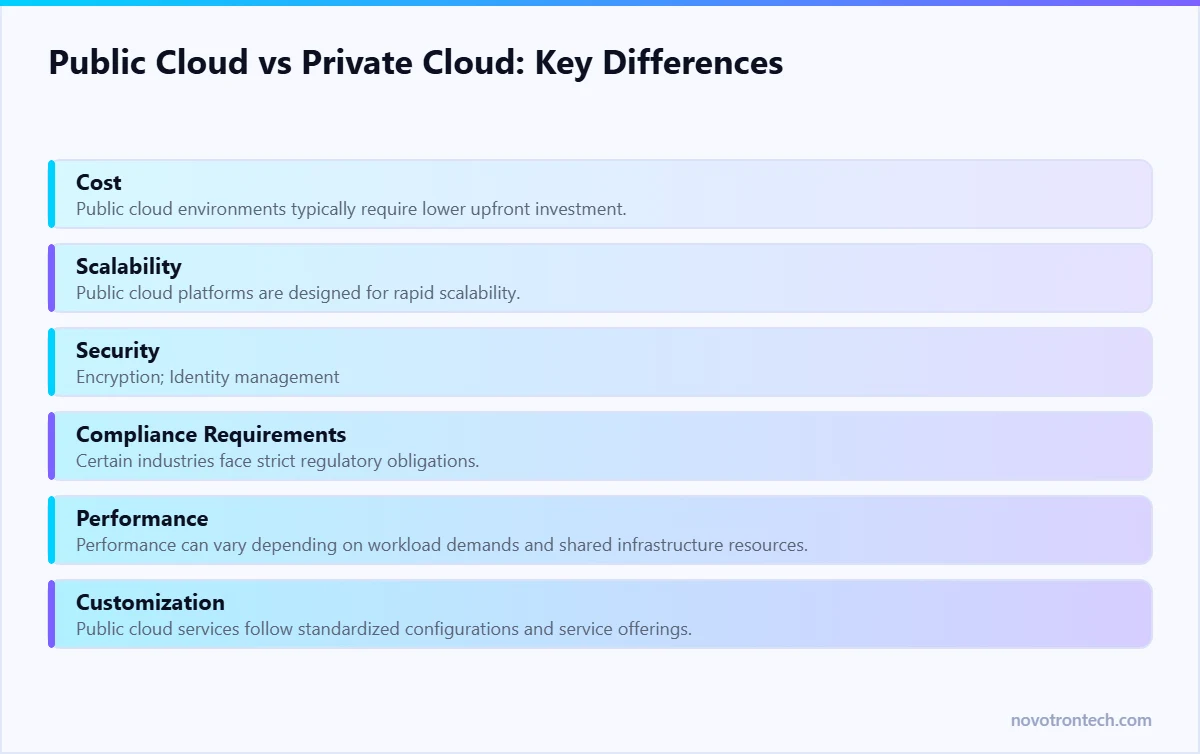
Public Cloud vs Private Cloud: Key Differences
1. Cost
Public Cloud
Public cloud environments typically require lower upfront investment.
Businesses benefit from:
- Pay-as-you-go pricing
- Reduced hardware costs
- Lower maintenance expenses
- Flexible resource allocation
This makes public cloud an attractive option for startups and growing businesses.
Private Cloud
Private cloud environments require dedicated infrastructure and management resources.
Costs may include:
- Hardware investments
- Data center expenses
- Ongoing maintenance
- Infrastructure management
While more expensive, private cloud provides greater control and customization.
2. Scalability
Public Cloud
Public cloud platforms are designed for rapid scalability.
Organizations can quickly increase or decrease resources based on demand.
This flexibility supports:
- Business growth
- Seasonal workloads
- New application deployments
Private Cloud
Private cloud scalability depends on available infrastructure capacity.
Scaling may require additional hardware or infrastructure investments.
3. Security
Public Cloud
Leading public cloud providers invest heavily in security technologies, including:
- Encryption
- Identity management
- Threat monitoring
- Compliance controls
However, businesses still share responsibility for securing applications, users, and data.
Private Cloud
Private cloud environments offer:
- Dedicated resources
- Greater access control
- Custom security policies
- Enhanced visibility
Organizations handling sensitive information often prefer private cloud deployments.
4. Compliance Requirements
Certain industries face strict regulatory obligations.
Examples include:
- Healthcare
- Financial Services
- Government Agencies
Private cloud environments often provide more control over compliance management and data governance.
However, many public cloud providers also support compliance frameworks through specialized services and certifications.
5. Performance
Public Cloud
Performance can vary depending on workload demands and shared infrastructure resources.
Modern public cloud platforms generally provide excellent performance for most business applications.
Private Cloud
Dedicated infrastructure often delivers more predictable performance and resource availability.
This can be important for mission-critical applications.
6. Customization
Public Cloud
Public cloud services follow standardized configurations and service offerings.
Customization options may be limited compared to private cloud environments.
Private Cloud
Organizations have greater flexibility to customize:
- Infrastructure
- Security policies
- Network architecture
- Application environments
This is beneficial for businesses with unique operational requirements.
Benefits of Public Cloud
Public cloud solutions offer several advantages:
Lower Initial Costs
Businesses avoid significant infrastructure investments.
Rapid Deployment
Resources can be provisioned quickly.
High Scalability
Organizations can adjust capacity as needed.
Global Accessibility
Teams can access services from virtually anywhere.
Reduced Maintenance
Cloud providers manage infrastructure updates and maintenance.
Benefits of Private Cloud
Private cloud environments provide:
Enhanced Security
Dedicated infrastructure reduces exposure risks.
Greater Control
Organizations manage infrastructure according to specific requirements.
Improved Compliance
Supports industry-specific regulatory needs.
Predictable Performance
Dedicated resources provide consistent performance.
Customization Flexibility
Businesses can tailor environments to their needs.
Which Businesses Should Choose Public Cloud?
Public cloud is often ideal for:
- Startups
- Small Businesses
- Growing Companies
- E-commerce Platforms
- Software Development Teams
- Organizations Seeking Cost Efficiency
Businesses focused on agility and scalability often benefit most from public cloud environments.
Which Businesses Should Choose Private Cloud?
Private cloud may be better suited for:
- Financial Institutions
- Healthcare Organizations
- Government Agencies
- Enterprises Handling Sensitive Data
- Businesses with Strict Compliance Requirements
Organizations requiring maximum control and security often prefer private cloud deployments.
Can Businesses Use Both?
Yes.
Many organizations adopt a Hybrid Cloud strategy that combines public and private cloud environments.
Hybrid cloud enables businesses to:
- Optimize costs
- Improve flexibility
- Maintain compliance
- Protect sensitive workloads
- Scale efficiently
Hybrid cloud adoption continues to grow as organizations seek the best of both deployment models.
Factors to Consider Before Choosing a Cloud Model
Before making a decision, businesses should evaluate:
Security Requirements
How sensitive is the data being stored?
Compliance Obligations
Are there industry regulations to follow?
Budget
What level of investment is available?
Scalability Needs
How quickly might resource requirements change?
Performance Expectations
Do applications require dedicated resources?
Business Objectives
How does the cloud strategy align with long-term goals?
A thorough assessment helps organizations choose the most appropriate solution.
Why Businesses Trust Novotron for Cloud Solutions
Choosing the right cloud environment requires more than technical knowledge.
Businesses need strategic guidance to align technology decisions with operational goals.
Novotron helps organizations:
- Assess cloud readiness
- Develop cloud strategies
- Execute cloud migrations
- Optimize cloud performance
- Strengthen cloud security
- Manage hybrid cloud environments
By combining technical expertise with business-focused consulting, Novotron helps organizations maximize the value of their cloud investments.
Hybrid Cloud: What Most Businesses Actually End Up With
The public-versus-private framing suggests a single decision. In practice the answer is usually workload by workload, and the resulting estate is hybrid whether or not anyone planned it that way.
- Public cloud for anything variable, customer-facing, or global: web applications, development and test environments, analytics, email and collaboration, disaster recovery targets.
- Private cloud or on-premise for latency-bound systems tied to local equipment, workloads with licensing that punishes public cloud, and steady-state systems on hardware with years of life left.
- Both, connected properly. The connection is where hybrid succeeds or fails — consistent identity, a private link rather than internet VPN for production traffic, and one monitoring and backup regime across both.
The failure mode is not choosing hybrid; it is running two estates with two sets of tools, two access models and two teams. That doubles cost and halves visibility.
The Cost Comparison Nobody Does Properly
Public cloud looks expensive on a monthly invoice and private looks expensive on a capital request, which is why the comparison usually gets decided by whichever budget is easier to approve. A fair comparison over a five-year window includes, for private: hardware and refresh, hypervisor and OS licensing, storage growth, power and cooling, rack or data centre costs, the DR site, and the engineering time to run it. For public: compute and storage at right-sized specifications after optimisation, egress charges, reserved or savings-plan discounts on steady workloads, and the governance effort to keep spend under control.
Two rules hold up across most estates. Variable and unpredictable workloads are cheaper in public cloud, because you stop paying for the peak. Large, flat, always-on workloads are often cheaper on owned hardware, provided you have somewhere to put it and someone to run it. Migration sequencing and cost drivers are covered in our cloud migration guide.
Security and Compliance: Different, Not Better or Worse
Private cloud is not inherently more secure. It gives you more control and hands you more responsibility — every patch, every configuration and every physical safeguard is yours. Public cloud providers run stronger physical and platform security than almost any mid-market business can, but the shared responsibility model leaves identity, configuration and data protection with you.
For DPDP purposes the distinction that matters is not public or private but where personal data resides, who can access it, and whether you can evidence both. All major providers operate Indian regions; the risk is usually a backup or replica quietly landing in another region. Confirm default and replica locations in writing. The obligations that fall on IT are listed in the DPDP Act compliance checklist.
A Decision Rule You Can Apply This Week
- Variable demand, or growth you cannot forecast → public cloud.
- Latency tied to on-site hardware → keep it local.
- Licence terms that penalise per-core cloud pricing → model both before committing; the licence often decides.
- Regulatory requirement for a named physical location → private, or a public region with contractual residency guarantees.
- No internal capacity to govern cloud spend and configuration → public cloud with a managed provider, not private with nobody to run it.
- Hardware refresh due within twelve months → the strongest natural trigger to move, because the capital request is already on the table.
Conclusion
Both Public Cloud and Private Cloud offer significant advantages.
Public cloud provides flexibility, scalability, and cost efficiency, making it ideal for many growing businesses.
Private cloud offers enhanced control, security, and customization, making it suitable for organizations with strict compliance or performance requirements.
The right choice depends on your business goals, security needs, compliance obligations, and growth strategy.
Many organizations find that a hybrid approach provides the best balance of flexibility and control.
By evaluating business requirements carefully, companies can build a cloud strategy that supports long-term success and digital transformation.
FAQs
What is the main difference between Public Cloud and Private Cloud?
Public Cloud resources are shared among multiple organizations, while Private Cloud infrastructure is dedicated to a single business.
Is Public Cloud more affordable than Private Cloud?
Generally, yes. Public cloud solutions require lower upfront investment and offer flexible pay-as-you-go pricing.
Which cloud model is more secure?
Both can be highly secure. Private cloud provides greater control, while public cloud providers offer advanced security technologies and compliance capabilities.
What is Hybrid Cloud?
Hybrid Cloud combines public and private cloud environments to provide flexibility, scalability, and enhanced control.
Which cloud deployment model is best for small businesses?
Public cloud is often the preferred choice for small and growing businesses due to its affordability, scalability, and ease of deployment.
Related: the complete cloud migration guide · our cloud solutions · managed IT services in Noida.