
Ask three firms for a quote on VAPT services in Noida and you will often get three different services described with the same four letters. One quotes a scanner run. Another quotes three weeks of manual testing. The third quotes something in between and hopes you will not ask. Because the word covers such a wide range of work, the only reliable way to compare proposals is to compare scope, method and deliverables rather than headline price.
This guide sets out what a penetration test should contain, how the work is actually performed, what the report has to prove, and which variables move the cost. It is written for buyers in Noida, Greater Noida, Gurugram and the wider Delhi NCR region who need testing for compliance, for a customer security review, or before a launch.
What VAPT services in Noida should actually include
Vulnerability assessment and penetration testing are two activities, not one. The assessment finds and catalogues weaknesses. The penetration test then attempts to exploit them, which is what separates a theoretical finding from a demonstrated risk.
Consequently a genuine engagement includes both, and the proposal should say how much of each you are buying. Watch for the ratio of automated to manual effort, since that single number explains most price differences. A scanner can enumerate missing patches in an afternoon. Only a tester can chain a weak password policy to an exposed admin panel and show what an attacker would actually reach.
At minimum, expect scoping and authorisation, reconnaissance, automated scanning with manual validation, controlled exploitation, privilege escalation attempts where in scope, a written report with evidence, a remediation discussion and a retest. If any of those are missing, the quote is for something narrower. Our page on what VAPT is and why it matters covers the fundamentals in more depth.
How VAPT services in Noida are actually delivered
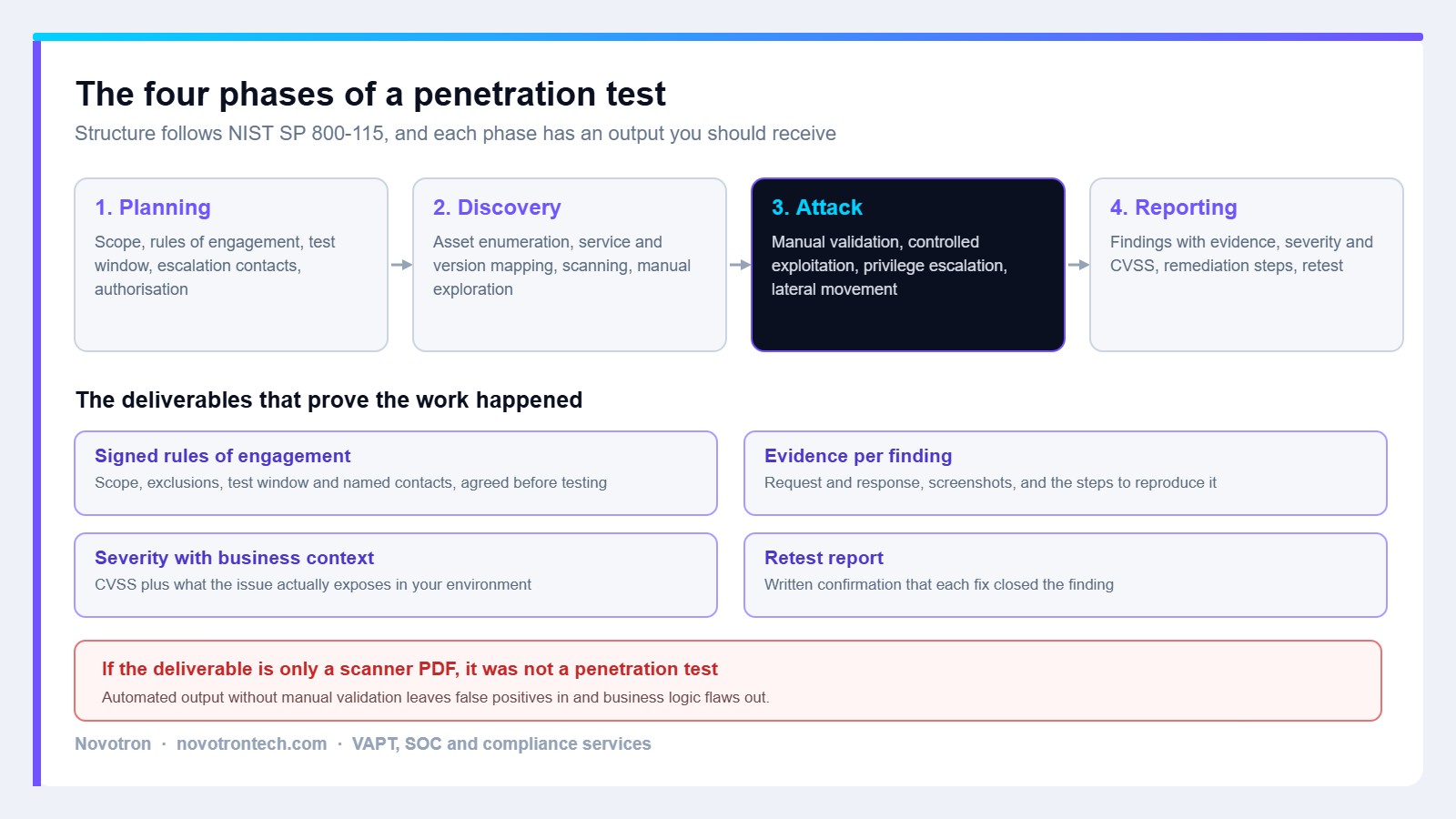
Structured testing follows the four phases set out in NIST SP 800-115. Here is what each involves in practice.
Planning. Both sides agree scope in writing: IP ranges, application URLs, which environments are in and out, the test window, whether social engineering counts as fair game, and who to call if something breaks. You sign the authorisation before the tester touches anything. Skipping this step is how testers end up scanning a third party’s infrastructure by accident.
Discovery. The tester enumerates assets, maps services and versions, and explores the application manually alongside automated scanning. Frequently this phase finds infrastructure the client did not know was exposed, such as a forgotten staging environment.
Attack. The tester validates scanner output by hand to remove false positives, then exploits confirmed issues within the agreed safety constraints. Where permitted, the tester escalates privileges and moves laterally to demonstrate real impact. This phase carries the expertise, and therefore the cost.
Reporting. The tester writes up each finding with evidence, severity, business context and specific remediation steps. Afterwards, once your team has applied fixes, a retest confirms each finding is closed.
Vulnerability scan, penetration test or red team
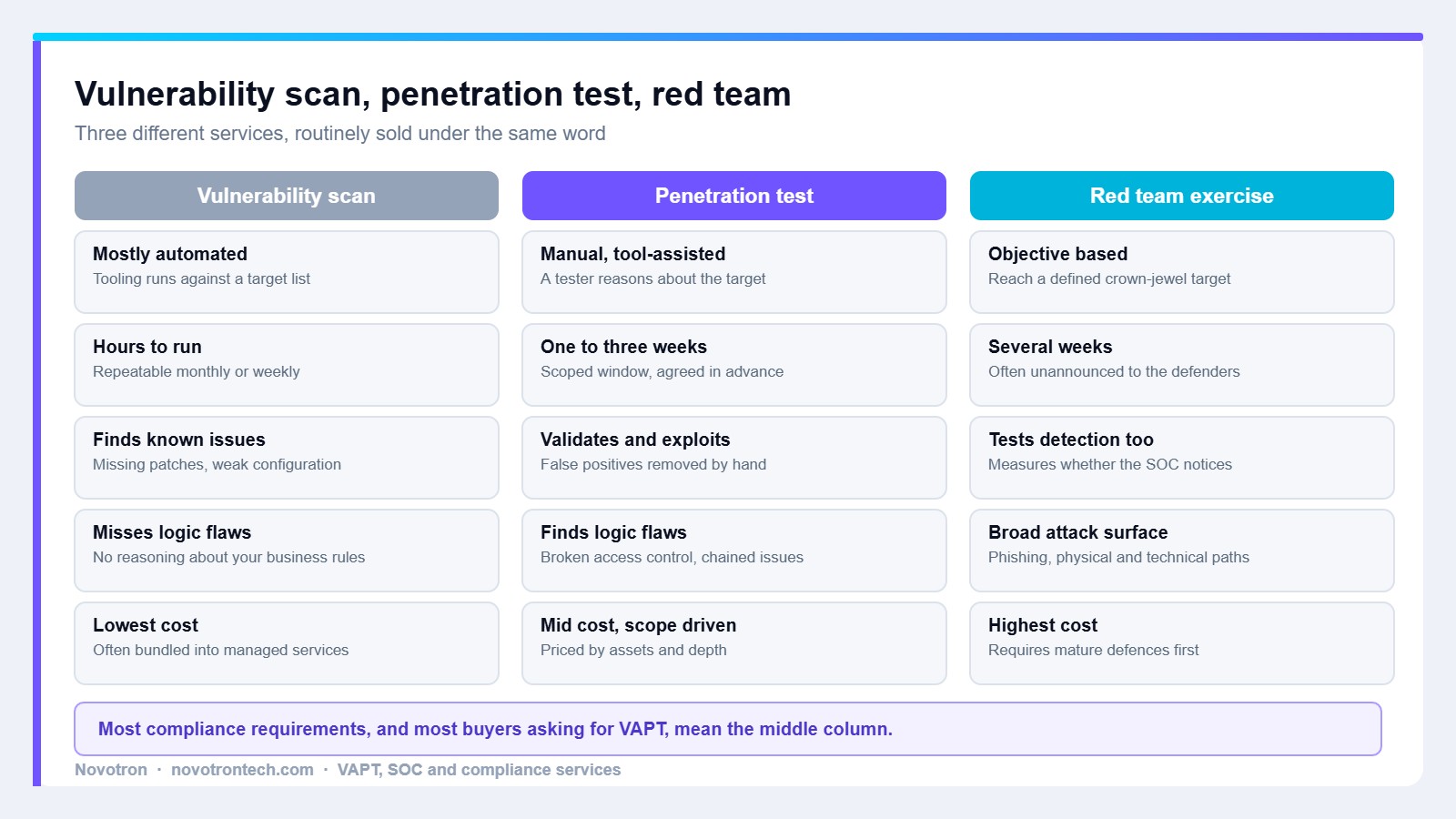
Confusion between these three causes most quote disputes. A vulnerability scan runs largely on tooling and repeats easily, so it belongs in your monthly routine rather than in an annual engagement. A penetration test is manual work assisted by tooling, scoped to a window, and validated by a human. A red team exercise is objective-based, usually unannounced, and measures whether your defenders notice.
Most compliance requirements, and most buyers who ask for VAPT, mean the middle option. Red teaming is worth commissioning only once detection and response are mature, which our notes on managed detection and response and SOC support explain.
The scope of work: what belongs in the contract
Ambiguous scope is the single biggest cause of disappointing tests. Insist that the statement of work names the following items explicitly.
- Asset inventory. Every IP range, domain, application and API endpoint in scope, with exclusions listed separately.
- Test type. Black box, grey box or white box, and whether credentials and documentation will be supplied.
- Environment. Production or staging, and if production, the agreed rate limits and blackout windows.
- Roles tested. Which user privilege levels the tester will hold, since access control flaws only appear across roles.
- Rules of engagement. Permitted techniques, prohibited actions, escalation contacts and stop conditions.
- Effort. Tester days, not just a fixed fee, so you can compare two proposals meaningfully.
- Retest terms. Whether a retest is included, how long the window lasts, and what it covers.
Grey box testing usually gives the best value, because supplying credentials removes days of guesswork and redirects effort toward the authenticated areas where serious flaws live.
What VAPT services in Noida must deliver in the report
The report is the product. Judge a provider by a redacted sample before signing, since the quality difference is immediately visible.
A usable report separates an executive summary from technical detail, so that leadership and engineers each get what they need. Every finding should carry reproduction steps, evidence such as requests and screenshots, a severity rating with CVSS, and remediation guidance specific to your stack rather than a generic paragraph. Additionally, the report should rank findings by business impact, because a medium-severity flaw on a payment path often matters more than a high-severity one on a brochure site.
Equally important, the report should state what was not tested. Honest limitations tell you where residual risk sits. Finally, insist on the retest report as a separate deliverable, since that is the document your auditor or enterprise customer will actually want.
What VAPT services in Noida and Delhi NCR cost
Price follows scope and effort, which is why rate cards mislead. Six variables move the number more than anything else.
| Variable | Why it changes the price |
|---|---|
| Asset count | Ten live IPs and one application is a different job from four applications and a data centre range |
| Application complexity | Role count, workflow depth and API surface drive tester days directly |
| Test type | Black box consumes days on reconnaissance that grey box skips |
| Manual proportion | The share of effort spent validating and exploiting rather than scanning |
| Retest inclusion | A bundled retest costs more upfront and far less than commissioning one later |
| Compliance requirements | Evidence formats for ISO 27001, SOC 2 or a client audit add reporting effort |
For current price bands in rupees, our detailed guide to VAPT cost in India sets them out, and cyber security services in Noida covers VAPT alongside SOC monitoring. Rather than repeat those figures here, the more useful advice is how to read a quote.
Ask every provider for tester days and the manual proportion. Two quotes that look similar often differ by a factor of three on that measure. Moreover, a quote materially cheaper than the rest is usually a scanner run with a report template, which has its place but will not satisfy a serious security review. Our comparison of cyber security audit costs makes the same point for audits.
How to choose between VAPT services in Noida
Location matters less than it used to, since most testing is remote. Even so, an NCR-based team can attend a scoping workshop in person, sit with your developers during remediation, and handle on-site internal network testing without travel cost. For internal segmentation and wireless testing, that proximity is genuinely useful.
Beyond location, weigh four things. Firstly, check whether testers hold recognised certifications and ask who specifically will run your engagement. Secondly, request a redacted report. Thirdly, confirm the retest is included. Fourthly, if your obligations involve government or regulated sectors, ask whether the provider is CERT-In empanelled, because certain audits require an empanelled organisation.
On that last point, be precise about what your requirement actually says. Specific regulated audits do require an empanelled organisation, yet many enterprise security reviews simply want competent testing and a credible report. Our guide to CERT-In compliance in India covers the surrounding obligations, including the requirement under direction No. 20(3)/2022-CERT-In to report listed cyber incidents within six hours and to retain ICT system logs for a rolling 180 days within Indian jurisdiction.
How we measure success on a penetration test
Because a test that finds nothing is usually a scoping failure rather than good news, judge the engagement on process quality. The framework below is what we apply; treat it as an evaluation method rather than a published benchmark.
| Measure | What good looks like |
|---|---|
| Coverage against scope | Every in-scope asset and user role was reached and tested |
| False positive rate | Findings survive your engineers’ review, because each was validated manually |
| Reproducibility | Your developers can reproduce every finding from the report alone |
| Remediation throughput | Share of findings closed and confirmed at retest within the agreed window |
| Business relevance | Severity reflects real exposure, not just the raw CVSS score |
| Detection signal | Whether your monitoring noticed the testing, which tells you about the SOC |
That last row is frequently overlooked. If a three-week test generated no alerts at all, you have learned something important about your risk posture beyond the findings list.
Novotron compared with other testing options
Three routes are common, and each fits a different situation.
| Criterion | Automated scanning tool | Large consultancy | Novotron |
|---|---|---|---|
| Manual validation | None | Extensive | Manual testing with tool assistance |
| Turnaround | Same day | Often weeks to schedule | Scheduled within the NCR region |
| Remediation support | Not offered | Usually a separate engagement | Included through to retest |
| On-site internal testing | Not applicable | Travel costs apply | Local to Noida and Delhi NCR |
| Wider security services | None | Broad | SOC, hardening, DLP and phishing simulation |
| Best fit | Continuous monitoring between tests | Large regulated programmes | Mid-sized businesses needing depth and support |
To be clear, scanning tools are genuinely useful. Run one continuously between annual tests, then use the penetration test for the depth a scanner cannot reach. Our security hardening and phishing exercise services cover the layers around it.
Pros and cons of a local NCR testing partner
Where it helps. On-site internal network and wireless testing happen without travel charges, which matters when the scope includes your office or plant. Scoping workshops and remediation sessions can be face to face, and that usually shortens the fix cycle considerably. Furthermore, a single partner covering testing, hardening and monitoring removes the handoffs that slow remediation down.
Where it does not. A regional firm cannot match the specialist research depth of a large product security boutique, so genuinely novel targets such as custom hardware or a bespoke protocol may need a specialist. Additionally, if your obligation specifically requires a CERT-In empanelled auditor, confirm empanelment status directly rather than assuming it, and choose accordingly. Saying so plainly is more useful than pretending every provider fits every requirement.
A worked example: a fintech pre-launch test
A Noida payments company needed testing before onboarding its first enterprise client. Initially they asked for a quote on one web application. During scoping, however, two things emerged: a partner-facing API sat outside the original scope, and the application had four user roles rather than the two described.
Both changes mattered. The API turned out to hold the most serious finding, an access control flaw that let one merchant query another merchant’s transaction references. Notably, no scanner would have found it, since the request was well-formed and the flaw sat in the authorisation logic.
The lesson is about scoping rather than tooling. Had the test run against the original scope, it would have produced a clean report and a false sense of security. Therefore, spend real time on scoping, and treat any provider who skips that conversation with caution.
Frequently asked questions
How much do VAPT services in Noida cost?
Cost depends on asset count, application complexity, test type and whether a retest is included, so a figure quoted before scoping is guesswork. Ask for tester days and the manual proportion instead, because those two numbers explain most of the difference between quotes. Our VAPT cost guide sets out current price bands in detail.
Do VAPT services in Noida have to be CERT-In empanelled?
Not always. Certain regulated and government audits require an empanelled organisation, whereas many enterprise security reviews simply want competent testing and a credible report. Check the exact wording of your obligation first, then confirm the provider’s status directly rather than relying on marketing claims.
How long does a penetration test take?
A single web application typically takes five to ten working days of testing, plus reporting time. Larger scopes covering multiple applications, an internal network and APIs commonly run three to four weeks. Scheduling usually adds a further one to two weeks, so plan ahead of any launch or audit deadline.
How often should we run VAPT?
Annually as a baseline, and additionally after any significant change such as a major release, an infrastructure migration or a new integration. Between tests, continuous vulnerability scanning covers newly disclosed issues. Many enterprise customers and insurers now ask for evidence of testing within the previous twelve months.
Will testing disrupt our production systems?
It should not, provided the rules of engagement are agreed properly. Most teams test against production, and they set rate limits, blackout windows and stop conditions in advance. Where the risk is genuinely unacceptable, testing runs against a staging environment that mirrors production configuration.
What is the difference between VAPT and a security audit?
VAPT is technical testing that finds and exploits weaknesses in systems. A security audit assesses controls, policies and processes against a standard such as ISO 27001. The two are complementary, and audits frequently require recent test results as evidence, which our ISO 27001 guide explains.
Book a scoping call
If you need testing before a launch, an audit or a customer security review, the useful first step is a scoping conversation rather than a price. Novotron runs VAPT engagements across Noida, Greater Noida, Gurugram and Delhi NCR, with manual testing, evidence-based reporting and a retest included.
When you are ready to test, see our VAPT services company in Delhi NCR page and wider cyber security services, or contact our team to scope your environment. We are based at Sector 135, Noida, and reachable on +91-8130009878.