Why Businesses Are Turning to Managed Detection and Response
Cyber threats are becoming more sophisticated, persistent, and difficult to detect. Businesses now face ransomware, phishing attacks, credential theft, malware, insider threats, cloud security risks, and other advanced cyber incidents.
Traditional security tools remain important, but technology alone may not be enough.
A firewall can block known malicious traffic. Endpoint security can identify suspicious activity. A Security Information and Event Management (SIEM) platform can collect and analyze security logs. However, these tools may generate large volumes of alerts that require continuous investigation.
Many organizations do not have enough in-house cyber security professionals to monitor security events 24/7, investigate every alert, and respond quickly to confirmed threats.
This is where Managed Detection and Response (MDR) becomes valuable.
MDR combines advanced threat detection technology with experienced cyber security professionals who continuously monitor an organization’s environment, investigate suspicious activity, and help contain active threats.
Instead of relying only on automated alerts, MDR provides an operational security service that helps organizations detect, understand, and respond to cyber threats.
In this guide, you will learn what Managed Detection and Response is, how MDR works, its key benefits, and why businesses increasingly use MDR services to strengthen their cyber security posture.
What Is Managed Detection and Response?
Managed Detection and Response (MDR) is a managed cyber security service that provides continuous threat monitoring, advanced threat detection, security investigation, and expert-led incident response.
MDR providers use a combination of:
- Security analytics
- Endpoint detection technology
- Threat intelligence
- Security monitoring tools
- Automated detection
- Human-led investigation
- Incident response expertise
The goal is to identify suspicious behavior, determine whether it represents a genuine threat, and take appropriate action before the incident causes significant business damage.
An MDR service may monitor:
- Employee endpoints
- Servers
- Cloud workloads
- User accounts
- Network activity
- Email environments
- Security logs
- Identity systems
- Business applications
MDR provides more than security alerts. It adds expert analysis and response capabilities that help organizations manage threats more effectively.
How Does Managed Detection and Response Work?
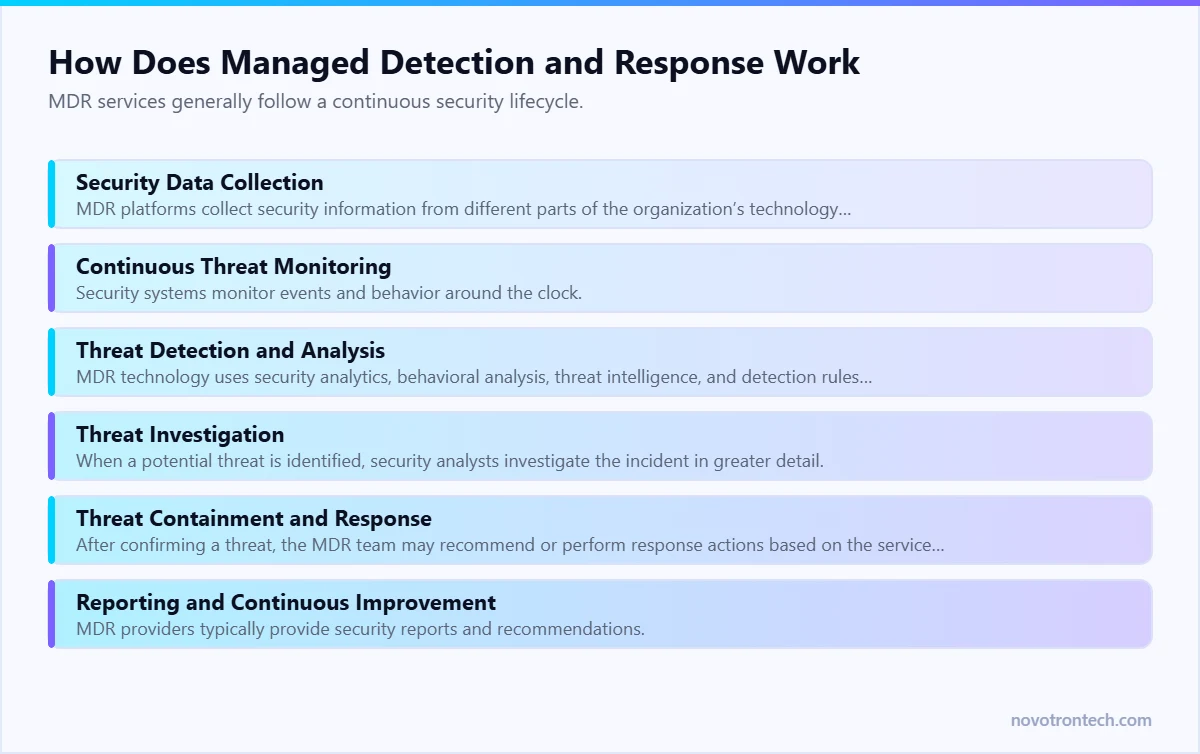
MDR services generally follow a continuous security lifecycle.
1. Security Data Collection
MDR platforms collect security information from different parts of the organization’s technology environment.
Data sources may include:
- Laptops and desktops
- Servers
- Cloud platforms
- Endpoint security tools
- Firewalls
- Identity systems
- Email security platforms
- Network devices
- Security logs
This creates broader visibility across the organization.
2. Continuous Threat Monitoring
Security systems monitor events and behavior around the clock.
They look for indicators such as:
- Unusual login activity
- Suspicious file execution
- Unexpected privilege changes
- Abnormal network connections
- Potential malware activity
- Unusual data access
- Suspicious user behavior
Continuous monitoring helps identify threats that may occur outside normal business hours.
3. Threat Detection and Analysis
MDR technology uses security analytics, behavioral analysis, threat intelligence, and detection rules to identify potentially malicious activity.
However, not every alert represents a real attack.
Security analysts investigate suspicious events to determine:
- Whether the activity is malicious
- Which systems are affected
- How the threat entered
- Whether the threat is still active
- What response may be required
Human analysis helps reduce false positives and provides important context.
4. Threat Investigation
When a potential threat is identified, security analysts investigate the incident in greater detail.
They may review:
- Security logs
- Endpoint activity
- User behavior
- Authentication events
- Network connections
- File activity
- Threat intelligence
The objective is to understand the scope and severity of the incident.
5. Threat Containment and Response
After confirming a threat, the MDR team may recommend or perform response actions based on the service model and agreed procedures.
Actions may include:
- Isolating a compromised endpoint
- Blocking malicious activity
- Disabling a compromised account
- Terminating suspicious processes
- Restricting unauthorized access
- Escalating a critical incident
- Providing remediation guidance
Fast containment can reduce the impact of a cyber incident.
6. Reporting and Continuous Improvement
MDR providers typically provide security reports and recommendations.
These may include:
- Detected threats
- Incident severity
- Response actions
- Security trends
- Identified risks
- Recommended improvements
Organizations can use these insights to strengthen their long-term security posture.
Key Components of MDR Services
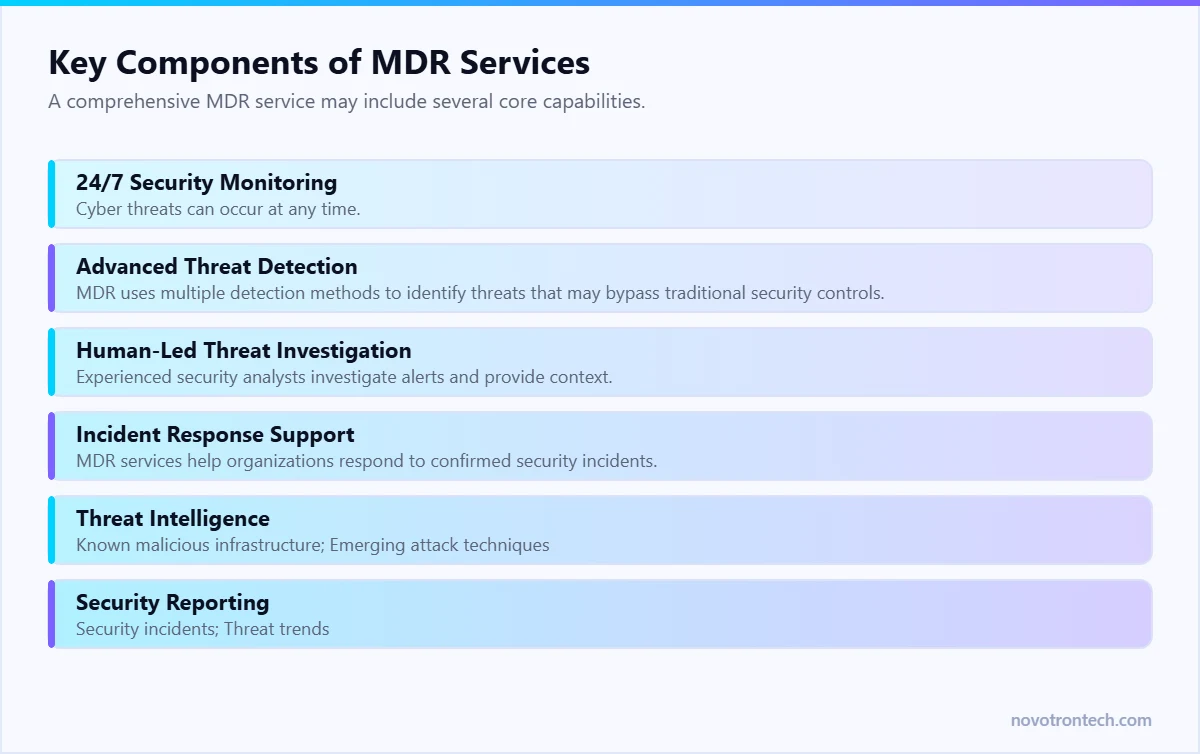
A comprehensive MDR service may include several core capabilities.
24/7 Security Monitoring
Cyber threats can occur at any time.
Continuous monitoring helps organizations identify suspicious activity even when internal IT teams are unavailable.
Advanced Threat Detection
MDR uses multiple detection methods to identify threats that may bypass traditional security controls.
These methods may include:
- Behavioral analytics
- Threat intelligence
- Endpoint telemetry
- Security correlation
- Anomaly detection
Human-Led Threat Investigation
Experienced security analysts investigate alerts and provide context.
This helps organizations prioritize genuine threats instead of spending time on low-risk or false-positive alerts.
Incident Response Support
MDR services help organizations respond to confirmed security incidents.
Response support may include containment guidance, remediation recommendations, incident escalation, and recovery assistance.
Threat Intelligence
Threat intelligence provides information about:
- Known malicious infrastructure
- Emerging attack techniques
- Malware activity
- Threat actor behavior
- Indicators of compromise
This information can improve threat detection and investigation.
Security Reporting
Regular reporting helps organizations understand:
- Security incidents
- Threat trends
- Detection activity
- Response performance
- Security risks
Reports can support management decisions and cyber security planning.
Benefits of Managed Detection and Response
In short, the main benefits of managed detection and response are: threats are spotted and contained faster, the business gets 24/7 coverage without hiring a full security team, experienced analysts investigate alerts instead of leaving them in a queue, and management gets clear reporting on what happened and what was fixed. Each benefit is explained below.
Faster Threat Detection
MDR continuously monitors security activity and can identify suspicious behavior earlier.
Earlier detection may reduce the time attackers have to move through an environment.
Faster Incident Response
When a threat is confirmed, security teams can begin containment and remediation more quickly.
Rapid response can reduce operational disruption and potential business impact.
24/7 Security Coverage
Many businesses do not have the resources to operate an internal cyber security team around the clock.
MDR provides continuous monitoring without requiring the organization to build and staff a full internal security operations team.
Access to Cyber Security Expertise
MDR gives organizations access to experienced security analysts and incident response professionals.
This can be especially valuable for small and medium-sized businesses with limited internal security resources.
Reduced Alert Fatigue
Security tools can generate large numbers of alerts.
MDR analysts investigate and prioritize alerts, helping internal teams focus on incidents that require attention.
Improved Visibility
MDR can provide visibility across endpoints, cloud environments, identities, networks, and security tools.
Broader visibility helps organizations identify threats that may otherwise remain unnoticed.
Better Ransomware Readiness
MDR can help detect suspicious activity associated with ransomware, such as unusual file behavior, malicious processes, credential misuse, or lateral movement.
Early detection and containment may reduce the scope of an attack.
Improved Security Posture
MDR reporting and recommendations can help organizations identify security gaps and improve their overall cyber security strategy.
Predictable Security Operations
Managed services can provide access to ongoing monitoring and response capabilities without the cost and complexity of building a complete in-house security operation.
Common Cyber Threats MDR Can Help Detect
MDR services can support the detection and investigation of many types of threats.
Ransomware
Ransomware may encrypt business data and disrupt critical operations.
MDR can help identify suspicious activity associated with ransomware and support rapid containment.
Phishing and Credential Theft
Attackers often use phishing to steal usernames, passwords, or authentication information.
MDR may identify unusual account activity and suspicious login behavior.
Malware
Malware can compromise systems, steal information, disrupt operations, or create unauthorized access.
Endpoint monitoring can help identify suspicious processes and malicious behavior.
Account Compromise
Compromised accounts may be used to access sensitive information or move through business systems.
MDR can investigate unusual authentication events and abnormal account behavior.
Insider Threats
Insider risks may result from malicious activity, excessive access, or accidental actions.
Behavioral monitoring can help identify unusual access patterns that require investigation.
Lateral Movement
After gaining access, attackers may attempt to move between systems.
MDR can help identify suspicious internal activity and support containment.
Cloud Security Threats
Cloud environments can be affected by:
- Misconfigured access
- Compromised accounts
- Unauthorized activity
- Suspicious resource changes
can provide additional monitoring and investigation capabilities across supported cloud environments.
MDR vs SOC vs SIEM: What Is the Difference?
, SOC, and SIEM are related but serve different functions.
| Capability | MDR | SOC | SIEM |
|---|---|---|---|
| Main Purpose | Managed threat detection and response | Security operations and monitoring | Security log collection and analysis |
| Technology | Uses multiple security tools | Uses security platforms and processes | Centralizes and correlates security logs |
| Human Expertise | Included as part of the service | Depends on the SOC model | Usually requires security analysts |
| 24/7 Monitoring | Common | Common | Technology can operate continuously |
| Threat Investigation | Included | Included | Provides data for investigation |
| Incident Response | Included or supported | Usually included | Not typically provided by the platform alone |
| Service Model | Managed service | Internal, outsourced, or hybrid | Security technology platform |
A SIEM is primarily a technology platform.
A SOC is an operational security function.
MDR is a managed service that combines technology, expert monitoring, investigation, and response.
These capabilities can work together as part of a broader cyber security strategy.
MDR vs EDR: What Is the Difference?
Endpoint Detection and Response (EDR) focuses primarily on detecting and investigating suspicious activity on endpoints such as laptops, desktops, and servers.
Managed Detection and Response (MDR) is a managed security service that may use EDR technology while adding:
- Security analysts
- Continuous monitoring
- Threat investigation
- Incident response
- Threat intelligence
- Security guidance
EDR provides important security technology.
MDR adds managed expertise and operational response.
Why Do Businesses Need MDR Services?
Businesses face increasing cyber risks while managing more complex technology environments.
Common challenges include:
- Limited cyber security staff
- Lack of 24/7 monitoring
- Too many security alerts
- Slow incident investigation
- Limited threat response capabilities
- Growing cloud environments
- Remote and hybrid work
- Increasing ransomware risks
MDR helps address these challenges by providing ongoing monitoring and expert-led threat response.
MDR may be especially valuable for:
- Small and medium-sized businesses
- Growing enterprises
- Organizations with limited security teams
- Businesses operating cloud environments
- Companies supporting remote employees
- Organizations handling sensitive information
- Businesses seeking stronger cyber resilience
How to Choose an MDR Service Provider
Not all MDR services provide the same capabilities.
Businesses should evaluate the following areas.
Monitoring Coverage
Confirm which systems and environments are included.
Ask whether the service supports:
- Endpoints
- Servers
- Cloud workloads
- Identity systems
- Networks
- Email environments
Security Operations Availability
Understand whether monitoring is available 24/7 and whether security analysts investigate alerts continuously.
Incident Response Capabilities
Ask what happens after a threat is confirmed.
Determine whether the provider can:
- Isolate affected systems
- Support containment
- Provide remediation guidance
- Assist with incident recovery
Integration Capabilities
The MDR service should work with relevant security and IT tools.
Reporting and Communication
Review the type of reports and alerts provided.
Clear communication helps internal teams understand risks and response actions.
Industry Experience
Choose a provider with relevant experience and technical expertise.
Scalability
The service should support future growth, additional users, cloud workloads, and changing business requirements.
Best Practices for Using MDR Effectively
MDR works best as part of a broader security strategy.
Businesses should:
- Maintain strong identity and access controls
- Use Multi-Factor Authentication
- Keep systems updated
- Conduct regular vulnerability assessments
- Implement endpoint protection
- Maintain secure backups
- Test incident response procedures
- Train employees to identify phishing attacks
- Review security reports regularly
- Define clear response responsibilities
MDR strengthens cyber security, but it should not be treated as the only security control.
A layered approach provides stronger protection.
Why Businesses Choose Novotron for MDR Services
Effective cyber security requires more than deploying security tools. Businesses need continuous visibility, experienced threat analysis, and a structured response process.
Novotron helps organizations strengthen their cyber security operations through managed security solutions designed to support proactive threat detection and faster incident response.
Novotron’s cyber security capabilities include:
- Managed Detection and Response
- 24/7 Security Monitoring
- Threat Detection and Investigation
- Cyber Incident Response Support
- Security Operations Center Support
- SIEM Monitoring
- Endpoint Security
- Endpoint Detection and Response
- Vulnerability Assessment and Penetration Testing
- Identity and Access Management
- Cloud Security
- Network Security
- Cyber Security Consulting
By combining advanced security technologies with experienced professionals and proactive monitoring, Novotron helps businesses improve threat visibility and strengthen cyber resilience.
Conclusion
Cyber threats are becoming more advanced, and businesses need more than traditional security tools to protect their systems and data.
Managed Detection and Response combines continuous monitoring, advanced threat detection, expert investigation, and incident response support. It helps organizations identify suspicious activity earlier and respond more effectively to confirmed threats.
MDR is particularly valuable for businesses that do not have the resources to operate a large internal security team around the clock.
However, MDR should be part of a broader cyber security strategy that includes strong identity controls, endpoint protection, vulnerability management, secure backups, employee awareness, and tested incident response procedures.
By combining these controls, organizations can improve their ability to detect, contain, and recover from cyber incidents.
Novotron helps businesses strengthen cyber resilience through managed threat detection, security monitoring, incident response support, and end-to-end cyber security services.
Frequently Asked Questions
What is Managed Detection and Response?
Managed Detection and Response is a managed cyber security service that provides continuous threat monitoring, advanced detection, expert investigation, and incident response support.
How does MDR work?
MDR collects security information from supported systems, monitors activity, identifies suspicious behavior, investigates potential threats, and supports containment and remediation.
What is included in MDR services?
MDR services may include 24/7 monitoring, threat detection, security investigation, threat intelligence, incident response support, and security reporting.
What is the difference between MDR and EDR?
EDR is endpoint-focused security technology. MDR is a managed service that may use EDR while adding security analysts, continuous monitoring, investigation, and response.
Is MDR the same as a SOC?
No. A SOC is a security operations function that may be internal or outsourced. MDR is a managed service focused on threat detection, investigation, and response.
Can MDR help protect against ransomware?
MDR can help identify suspicious activity associated with ransomware and support faster investigation and containment. It should be combined with secure backups, endpoint protection, access controls, and other security measures.
Do small businesses need MDR?
Small businesses can benefit from MDR because they may not have the resources to maintain a 24/7 internal security team. Managed services can provide access to security expertise and continuous monitoring.
Does MDR replace other cyber security tools?
No. MDR should complement other security controls, including endpoint protection, identity security, vulnerability management, network security, employee training, and secure backups.
Related: what VAPT & SOC monitoring actually cost in Noida · 24/7 SOC support services · how to choose an IT partner in Noida.