Ask three vendors what a cyber security audit costs and you will get three answers that are not comparable, because they are quoting for three different things. One is offering a documentation review. One is offering technical testing. One is offering to walk you through certification. All three are legitimately called an audit.
This guide separates them, gives indicative Indian pricing for 2026, and ends with the checklist that decides whether your audit goes smoothly or drags on for months.
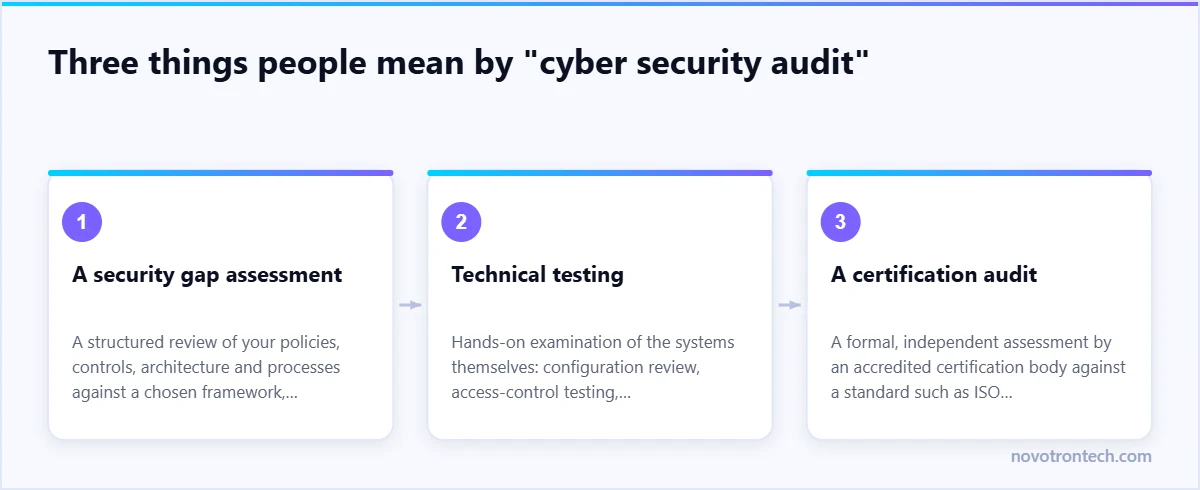
Three things people mean by “cyber security audit”
1. A security gap assessment
A structured review of your policies, controls, architecture and processes against a chosen framework, producing a prioritised list of gaps. No certificate is issued. This is the right starting point for most businesses, because it tells you how far you are from where you need to be before you commit to anything expensive.
Worth separating out here: a security gap assessment is not the same thing as a privacy readiness assessment. With India’s DPDP obligations taking effect in May 2027, a growing number of clients now run both — the security audit against ISO 27001 or CIS, and a separate DPDP readiness assessment scoring notice, consent, data principal rights, retention and breach reporting. They overlap on security safeguards and diverge everywhere else, and budgeting for one while assuming it covers the other is a common and expensive mistake. Our DPDP compliance checklist sets out what the privacy side involves.
2. Technical testing
Hands-on examination of the systems themselves: configuration review, access-control testing, vulnerability assessment and penetration testing. This is where you find out whether the controls described in your documents actually work. It is priced very differently from a paper audit — we cover it separately in our guide to VAPT cost in India.
3. A certification audit
A formal, independent assessment by an accredited certification body against a standard such as ISO 27001, resulting in a certificate your customers and regulators recognise. The certification body cannot also implement your controls, which is why certification projects usually involve two separate suppliers and two separate invoices.
What each type costs in India
| Type of audit | Indicative range | Typical duration |
|---|---|---|
| Gap assessment | ₹50,000 – ₹4,00,000 | 2 – 4 weeks |
| Technical testing (VAPT) | ₹75,000 – ₹12,00,000 | 1 – 8 weeks |
| ISO 27001 certification, year one | ₹2,00,000 – ₹15,00,000 | 3 – 6 months |
| Annual surveillance audit | ₹60,000 – ₹5,00,000 | 1 – 2 weeks |
The ranges are wide because company size, site count and framework all move the number substantially. A twenty-person software firm and a four-hundred-person manufacturer sit at opposite ends of every row.
ISO 27001 certification cost, broken down
Certification is the audit most Indian businesses end up budgeting for, usually because an enterprise customer asked. The cost splits into components that are worth pricing separately:
| Component | Indicative cost | Who provides it |
|---|---|---|
| Gap analysis | ₹50,000 – ₹4,00,000 | Consultant or internal team |
| ISMS implementation and consulting | ₹1,00,000 – ₹8,00,000 | Consultant |
| Tooling and software | ₹50,000 – ₹5,00,000 | Vendors |
| Staff awareness training | ₹25,000 – ₹3,00,000 | Consultant or platform |
| Stage 1 and Stage 2 audit fees | ₹80,000 – ₹10,00,000 | Accredited certification body |
As a rough planning figure, a well-prepared company of ten to a hundred people often completes year one in the ₹2 – ₹5 lakh range. Mid-sized organisations of a hundred to two hundred people more commonly land between ₹3.5 lakh and ₹10 lakh. Larger or multi-site enterprises run higher again.
Certification is not a one-off. Surveillance audits fall in years two and three at roughly ₹60,000 – ₹5,00,000 each, and full recertification comes around in year four. Budget for the three-year cycle rather than the certificate.
How long it takes
From kickoff to certificate, three to six months is normal. Smaller organisations with reasonable existing hygiene often finish in twelve to sixteen weeks. Businesses starting from no documented controls should plan for six months, because the delay is rarely the audit itself — it is writing policies, implementing controls and then generating enough evidence that the controls have been operating.
That last point catches people out. Auditors want to see records of a control working over a period, not a policy written the week before. Starting evidence collection early is the single cheapest way to shorten the timeline.
What drives the cost
- Headcount and site count. Certification body fees scale with both; multi-site scope adds audit days.
- Scope definition. Certifying one product line costs far less than certifying the whole organisation. Scope is the biggest lever you control.
- Starting maturity. A business with existing access reviews, logging and change control needs a fraction of the consulting effort.
- Framework count. ISO 27001 alongside SOC 2 shares evidence but adds audit work.
- Cloud versus on-premise. Cloud estates are usually faster to evidence; hybrid environments are the most effort.
- Whether technical testing is bundled. Many certification scopes require penetration testing evidence, which is a separate spend.
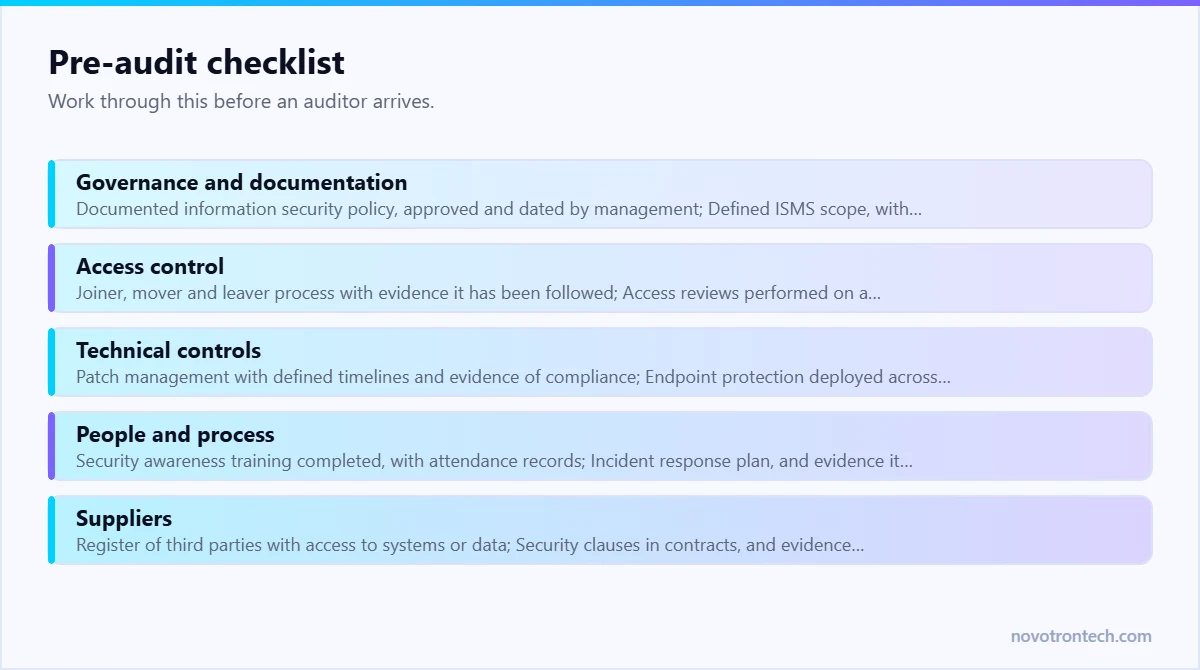
Pre-audit checklist
Work through this before an auditor arrives. Every item you cannot answer becomes a finding.
Governance and documentation
- Documented information security policy, approved and dated by management
- Defined ISMS scope, with boundaries and exclusions written down
- Current asset inventory covering hardware, software, data and cloud services
- Risk assessment with a documented methodology, and a risk treatment plan
- Statement of Applicability, with justification for excluded controls
- Records of management review meetings
Access control
- Joiner, mover and leaver process with evidence it has been followed
- Access reviews performed on a stated cycle, with records
- Multi-factor authentication on email, VPN and administrative accounts
- Privileged accounts inventoried, and shared accounts eliminated or justified
- Evidence that departed employees lost access promptly
Technical controls
- Patch management with defined timelines and evidence of compliance
- Endpoint protection deployed across the estate, with coverage reporting
- Centralised logging, with a documented retention period
- Backups running, encrypted, and — critically — restore-tested with records
- Encryption in transit and at rest, with key handling documented
- Network segmentation, and hardened baseline configurations
- Recent vulnerability assessment or penetration test, with remediation tracked
People and process
- Security awareness training completed, with attendance records
- Incident response plan, and evidence it has been tested
- Business continuity and disaster recovery plans with test records
- Change management process with approval records
- Background verification for staff in sensitive roles
Suppliers
- Register of third parties with access to systems or data
- Security clauses in contracts, and evidence of supplier review
- Cloud provider responsibility boundaries documented
Why audits fail the first time
Rarely because a control was missing. Almost always because evidence was missing. The three recurring causes:
- Policies with no operating record. The access review policy says quarterly; there are no records of a review ever happening.
- Backups never restore-tested. Backups run, nobody has proved they can be recovered.
- Scope drift. The scope statement names three systems; the auditor finds customer data in a fourth.
Choosing an auditor and a preparation partner
Keep them separate. The certification body must be accredited and independent, and cannot implement what it audits. Your preparation partner should be judged on whether they leave you with a working management system rather than a folder of templates.
Questions worth asking a preparation partner: how many certifications have you taken through to award, which certification bodies have you worked with, will you attend the audit, and what happens if we receive a major nonconformity?
Frequently asked questions
Do we need ISO 27001, or is a gap assessment enough?
If a customer contract or tender requires the certificate, you need certification. If you are trying to reduce risk, a gap assessment followed by remediation delivers most of the security benefit at a fraction of the cost.
Is penetration testing part of a compliance audit?
Not automatically, but most frameworks expect technical testing evidence, and many enterprise customers ask for a recent report alongside the certificate. Budget for both.
How often do we need to be audited?
ISO 27001 runs a three-year cycle: certification, then surveillance audits in years two and three, then recertification. Internal audits are expected at least annually throughout.
Can a small business realistically get certified?
Yes. A tightly scoped ISMS at a twenty-person company is a genuinely achievable project. Scope discipline is what keeps it affordable.
What is the cheapest way to reduce audit cost?
Narrow the scope and start evidence collection early. Those two decisions move the number more than any negotiation on day rates.
Planning your budget
Price the gap assessment first. Until you know how far you are from the standard, every other number is guesswork — and a gap assessment frequently reveals that the practical work is smaller, or larger, than assumed.
For structured assessments and certification preparation, see our compliance and security audit services. If the gaps turn out to be technical rather than procedural, our security hardening services and VAPT services cover the remediation side. You can also reach the team through our contact page.
All figures here are indicative market ranges for India in 2026, compiled for budgeting purposes. They are not a quotation and will vary by scope, framework and certification body.
See also: best cyber security companies in Noida (2026).