
Quick Answer
A cyber security risk assessment is a structured process used to identify important digital assets, evaluate cyber threats and vulnerabilities, estimate the likelihood and business impact of security incidents, and prioritize actions that reduce risk.
Businesses use cyber security risk assessments to understand where their security weaknesses exist and determine which risks require immediate attention.
A well-designed assessment helps organizations make informed security decisions instead of relying on assumptions or implementing controls without understanding the risks they address.
Cyber security risks are no longer limited to large enterprises.
Small businesses, growing companies, technology firms, financial organizations, healthcare providers, manufacturers, and professional service businesses all depend on digital systems to operate.
Organizations store customer information, employee records, financial data, intellectual property, business documents, and operational information across:
- Cloud platforms
- Business applications
- Employee devices
- On-premises servers
- Databases
- Email systems
- Third-party services
As technology environments become more connected, the number of potential cyber risks also increases.
A single compromised account, unpatched server, misconfigured cloud service, successful phishing attack, or exposed application can create significant operational and financial consequences.
Many organizations invest in security tools but still lack a clear understanding of their highest risks.
They may deploy firewalls, endpoint protection, antivirus software, or cloud security tools without knowing:
- Which business assets are most critical
- Which threats are most relevant
- Which vulnerabilities create the highest exposure
- Which security gaps require immediate action
- Whether current controls reduce risk effectively
A cyber security risk assessment helps answer these questions.
Rather than treating every risk as equally important, organizations can evaluate risk based on likelihood and potential business impact.
This enables security teams to prioritize resources and address the risks that matter most.
In this guide, you will learn what a cyber security risk assessment is, how the process works, which frameworks businesses can use, and how to build a practical risk management strategy.
What Is a Cyber Security Risk Assessment?
A cyber security risk assessment is the process of identifying, analyzing, and evaluating cyber risks that could affect an organization’s systems, data, operations, customers, or reputation.
The assessment generally examines five core areas:
- Business assets – What needs protection?
- Cyber threats – What could cause harm?
- Vulnerabilities – What weaknesses could be exploited?
- Business impact – What could happen if an incident occurs?
- Risk treatment – What actions should reduce or manage the risk?
The objective is not to eliminate every possible risk.
No organization can guarantee complete protection from every cyber threat.
Instead, risk assessment helps businesses understand their exposure and make informed decisions about how to manage risk.
Understanding Cyber Risk
Cyber risk can be understood as the possibility that a cyber threat may exploit a vulnerability and cause harm to an organization.
A simple way to think about risk is:
Cyber Risk = Likelihood of an Incident × Potential Business Impact
The likelihood may depend on factors such as:
- Exposure to the internet
- Known vulnerabilities
- Security control effectiveness
- Threat activity
- User behavior
- System configuration
The impact may include:
- Financial losses
- Business downtime
- Data exposure
- Regulatory consequences
- Customer impact
- Reputational damage
- Operational disruption
Risk assessments help organizations evaluate both likelihood and impact.
Why Is a Cyber Security Risk Assessment Important?
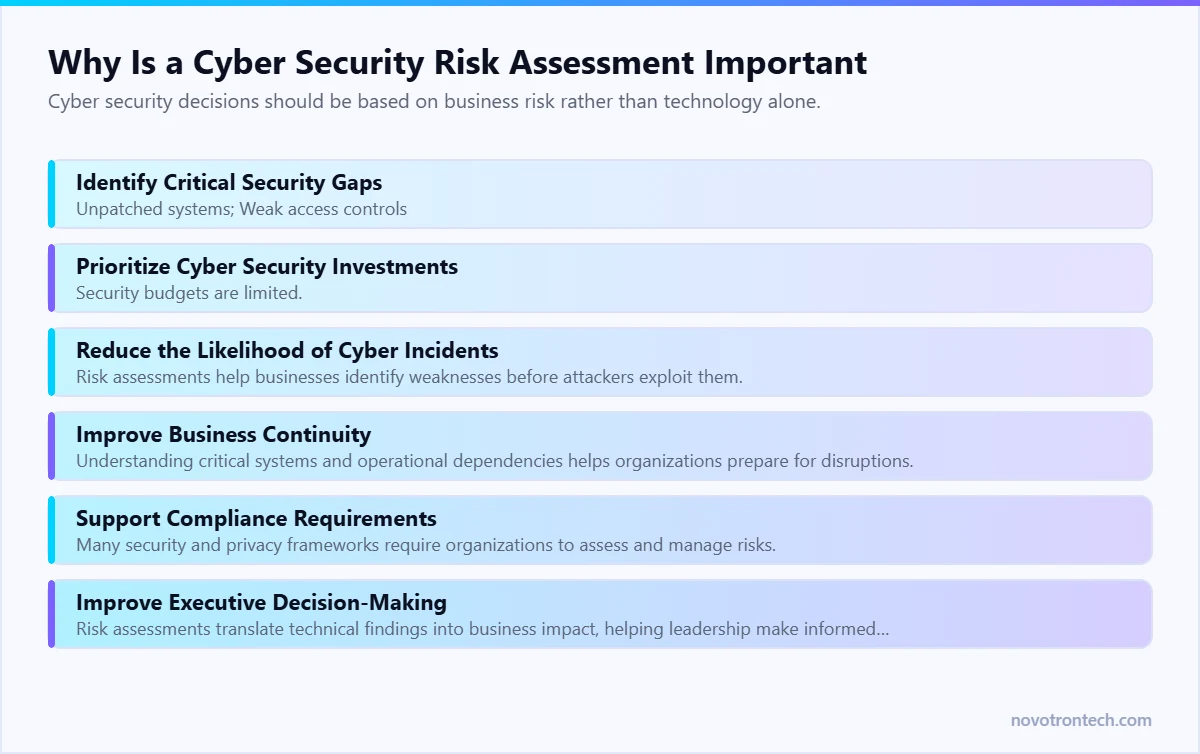
Cyber security decisions should be based on business risk rather than technology alone.
A risk assessment helps organizations understand which security issues could create the greatest impact.
Identify Critical Security Gaps
Security assessments can identify weaknesses such as:
- Unpatched systems
- Weak access controls
- Excessive user permissions
- Insecure cloud configurations
- Missing security monitoring
- Poor backup practices
- Outdated infrastructure
Identifying these gaps allows businesses to take corrective action.
Prioritize Cyber Security Investments
Security budgets are limited.
A risk-based approach helps organizations prioritize investments based on business importance.
For example, a vulnerability affecting a public-facing customer system may require faster action than a low-risk issue in an isolated internal environment.
Reduce the Likelihood of Cyber Incidents
Risk assessments help businesses identify weaknesses before attackers exploit them.
Early remediation can reduce the likelihood of successful attacks.
Improve Business Continuity
Understanding critical systems and operational dependencies helps organizations prepare for disruptions.
Risk assessments can support:
- Disaster recovery planning
- Incident response planning
- Backup strategies
- Business continuity planning
Support Compliance Requirements
Many security and privacy frameworks require organizations to assess and manage risks.
A structured assessment can support compliance planning and demonstrate that security risks are being reviewed systematically.
In India this is no longer optional. Under the Digital Personal Data Protection Act, the single largest penalty — up to Rs 250 crore — attaches to failing to take reasonable security safeguards where that failure leads to a personal data breach. A documented risk assessment is the evidence that those safeguards were considered and operating. Security leaders scoping that exposure can start with this overview of DPDP risk and breach reporting for CISOs, and our own DPDP Act compliance checklist sets out the seven obligations that land on IT.
Business leaders need clear information about cyber risk.
Improve Executive Decision-Making
Risk assessments translate technical findings into business impact, helping leadership make informed decisions.
Cyber Security Risk Assessment Process
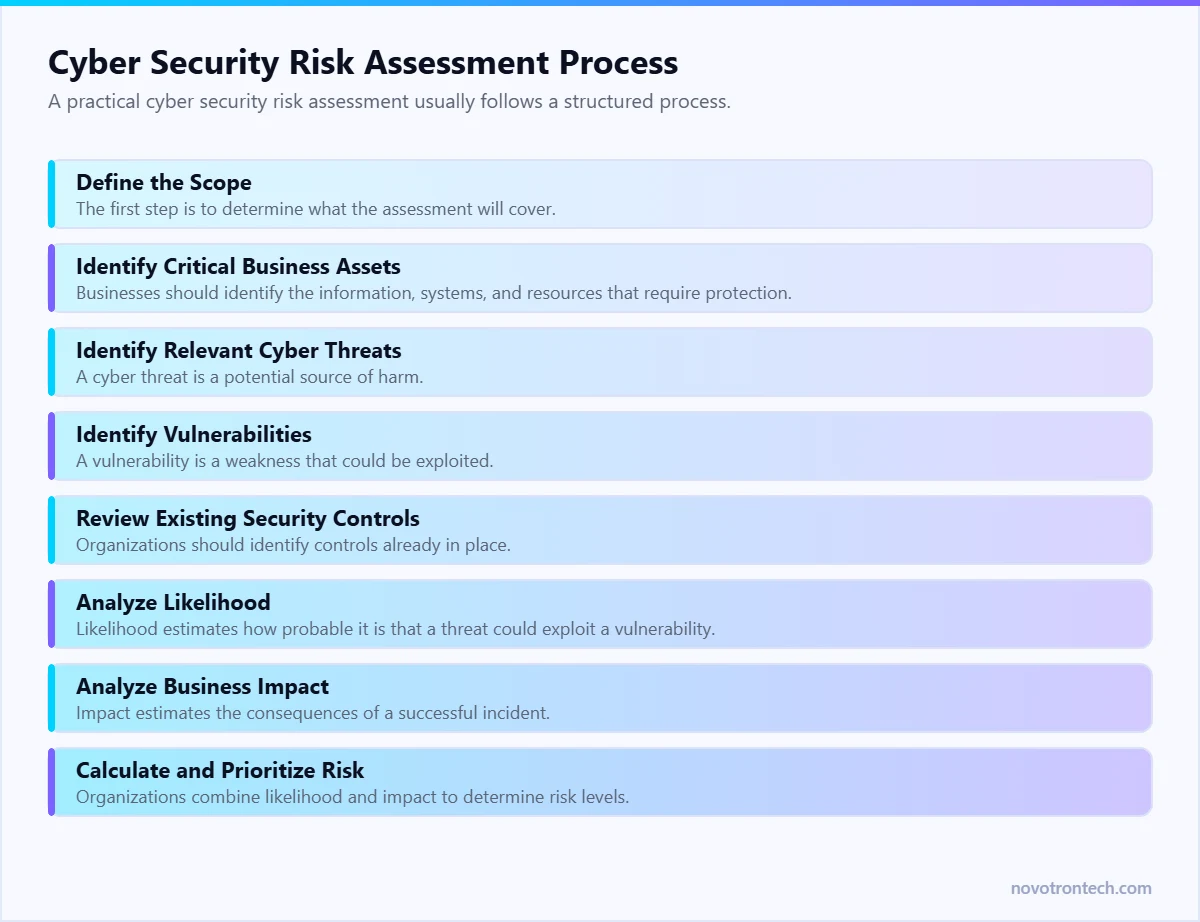
A practical cyber security risk assessment usually follows a structured process. To see every step applied to a real-world scenario, with a scored risk register and treatment plan, read our IT security risk assessment example.
Step 1: Define the Scope
The first step is to determine what the assessment will cover.
The scope may include:
- A complete organization
- A business unit
- A cloud environment
- A customer application
- A data center
- A specific IT system
- A third-party service
The scope should define:
- Systems included
- Data included
- Business processes included
- Locations included
- Assessment objectives
A clear scope prevents important assets from being overlooked.
Step 2: Identify Critical Business Assets
Businesses should identify the information, systems, and resources that require protection.
Common assets include:
- Customer data
- Employee information
- Financial records
- Business applications
- Databases
- Cloud accounts
- Intellectual property
- Email systems
- Production servers
- Network infrastructure
Assets should be classified based on business importance.
Important factors may include:
- Confidentiality
- Integrity
- Availability
- Business dependency
- Regulatory importance
Step 3: Identify Relevant Cyber Threats
A cyber threat is a potential source of harm.
Common threats include:
- Ransomware
- Phishing
- Malware
- Credential theft
- Account compromise
- Insider threats
- Data theft
- Denial-of-service attacks
- Cloud account compromise
- Supply chain attacks
Threat identification should consider the organization’s industry, technology environment, and business operations.
Step 4: Identify Vulnerabilities
A vulnerability is a weakness that could be exploited.
Examples include:
- Unpatched software
- Weak passwords
- Missing multi-factor authentication
- Excessive user permissions
- Misconfigured cloud storage
- Unsupported operating systems
- Insecure applications
- Poor network segmentation
- Inadequate security monitoring
Vulnerabilities may be identified through:
- Vulnerability assessments
- Penetration testing
- Configuration reviews
- Security audits
- Asset reviews
- Security monitoring
Step 5: Review Existing Security Controls
Organizations should identify controls already in place.
Examples include:
- Firewalls
- Endpoint protection
- Multi-factor authentication
- Access controls
- Data encryption
- Security monitoring
- Backup systems
- Employee awareness training
- Incident response procedures
The assessment should evaluate whether these controls operate effectively.
Step 6: Analyze Likelihood
Likelihood estimates how probable it is that a threat could exploit a vulnerability.
Factors may include:
- Ease of exploitation
- Exposure to the internet
- Availability of attack tools
- Existing security controls
- Threat activity
- Historical incidents
Organizations may use ratings such as:
- Low
- Medium
- High
- Critical
Step 7: Analyze Business Impact
Impact estimates the consequences of a successful incident.
Potential impacts include:
- Financial loss
- Business downtime
- Data exposure
- Customer disruption
- Legal or regulatory consequences
- Reputational damage
Impact should be evaluated from a business perspective.
Step 8: Calculate and Prioritize Risk
Organizations combine likelihood and impact to determine risk levels.
A simple risk matrix may include:
| Likelihood | Business Impact | Risk Priority |
|---|---|---|
| Low | Low | Low |
| Low | High | Medium |
| Medium | Medium | Medium |
| High | Medium | High |
| High | High | Critical |
The risk matrix helps organizations prioritize remediation.
Step 9: Select Risk Treatment Actions
Organizations can respond to risks in several ways.
Reduce the Risk
Implement controls that reduce likelihood or impact.
Examples:
- Apply security patches
- Enable multi-factor authentication
- Improve network segmentation
- Deploy endpoint security
Avoid the Risk
Stop or change an activity that creates unacceptable exposure.
Transfer the Risk
Transfer part of the financial impact through contracts or insurance.
Accept the Risk
Accept a risk when the cost of remediation is not justified by the expected impact.
Risk acceptance should be documented and approved by appropriate stakeholders.
Step 10: Document and Review
Cyber risks change over time.
New technologies, business processes, threats, and vulnerabilities can create new risks.
Organizations should review assessments regularly and update them after:
- Major system changes
- Cloud migrations
- Security incidents
- Business expansion
- New regulatory requirements
- Significant technology changes
Common Cyber Security Risks for Businesses
Ransomware
Ransomware can disrupt operations by encrypting or restricting access to business data.
Risk reduction measures may include:
- Secure backups
- Endpoint protection
- Security monitoring
- Network segmentation
- Employee awareness
Phishing
Phishing attacks attempt to trick users into revealing credentials or opening malicious content.
Controls may include:
- Employee training
- Email security
- Multi-factor authentication
- Security monitoring
Weak Identity and Access Management
Poor access controls can increase the risk of unauthorized access.
Businesses should use:
- Strong authentication
- Multi-factor authentication
- Role-based access
- Least-privilege access
- Regular access reviews
Unpatched Systems
Unpatched software may contain known vulnerabilities.
A structured patch management process helps reduce exposure.
Cloud Misconfigurations
Incorrect cloud settings can expose data or services.
Regular configuration reviews and cloud security monitoring can help identify risks.
Third-Party Risks
Vendors and service providers may have access to business systems or sensitive data.
Organizations should evaluate third-party security practices.
Cyber Security Risk Assessment Frameworks
Businesses may use established frameworks to structure risk assessments.
The NIST Cybersecurity Framework provides a structured approach to managing cyber security risks.
NIST Cybersecurity Framework
Its core functions include:
- Govern
- Identify
- Protect
- Detect
- Respond
- Recover
ISO/IEC 27001
ISO/IEC 27001 provides requirements for an Information Security Management System.
Risk assessment and risk treatment are central parts of the framework.
CIS Critical Security Controls
The CIS Controls provide prioritized security practices that help organizations reduce common cyber risks.
FAIR
Factor Analysis of Information Risk provides a framework for understanding and quantifying information risk.
Cyber security risk assessment and VAPT are related but different.
Cyber Security Risk Assessment vs VAPT
| Area | Cyber Security Risk Assessment | VAPT |
| Main Focus | Business and security risk | Technical vulnerabilities |
| Scope | Assets, threats, vulnerabilities, impact, controls | Systems, applications, networks |
| Business Impact | Core part of the assessment | May be included but is not the primary focus |
| Output | Risk register and treatment plan | Vulnerability findings and remediation recommendations |
| Purpose | Prioritize security risks | Identify and validate technical weaknesses |
VAPT can provide important technical input for a broader cyber security risk assessment.
Benefits of Regular Cyber Security Risk Assessments
Regular assessments help businesses:
- Identify new cyber risks
- Prioritize security improvements
- Reduce avoidable exposure
- Improve incident readiness
- Support compliance planning
- Improve business continuity
- Strengthen executive oversight
- Protect critical business assets
Cyber risk management should be continuous rather than a one-time project.
Best Practices for Cyber Security Risk Assessment
Align Risk with Business Objectives
Security priorities should reflect business priorities.
Critical customer systems may require stronger protection than low-impact internal tools.
Include Business and Technical Stakeholders
Effective assessments require input from:
- IT teams
- Cyber security teams
- Business leaders
- Compliance teams
- Legal teams
- Operations teams
Use Evidence
Risk ratings should be supported by:
- Asset inventories
- Security logs
- Vulnerability findings
- Configuration reviews
- Incident history
- Control assessments
Maintain a Risk Register
A risk register should document:
- Risk description
- Affected assets
- Threats
- Vulnerabilities
- Likelihood
- Impact
- Risk owner
- Treatment actions
- Review dates
Review Risks Continuously
Cyber risks change as technology and threats evolve.
Regular reviews help organizations maintain an accurate understanding of their risk exposure.
How Novotron Supports Cyber Security Risk Management
Effective cyber risk management requires visibility, technical expertise, and practical remediation planning.
Novotron helps businesses identify and manage cyber security risks through services that support proactive security improvement.
Novotron’s capabilities include:
- Cyber Security Risk Assessments
- Vulnerability Assessment and Penetration Testing
- Managed Detection and Response
- SOC Support
- SIEM Monitoring
- Endpoint Security
- Identity and Access Management
- Cloud Security
- Network Security
- Security Monitoring
- Incident Response Support
- Cyber Security Consulting
By combining risk assessment with technical security testing, continuous monitoring, and practical remediation support, Novotron helps organizations build stronger and more resilient cyber security programs.
Conclusion
Cyber security risk assessments help businesses understand where their most important risks exist and which actions should be prioritized.
A structured assessment identifies critical assets, relevant threats, vulnerabilities, existing controls, likelihood, and potential business impact.
The goal is not to eliminate every risk. The goal is to make informed decisions and manage risk at an acceptable level.
Regular assessments help organizations improve security, support business continuity, prioritize investments, and respond more effectively to changing cyber threats.
By combining risk assessment with VAPT, MDR, SOC support, security monitoring, and strong security controls, businesses can build a more proactive and resilient cyber security strategy.
Novotron helps organizations identify, prioritize, and reduce cyber risks through practical security assessments and managed cyber security services.
Frequently Asked Questions
What is a cyber security risk assessment?
A cyber security risk assessment is a structured process used to identify critical assets, threats, vulnerabilities, potential business impact, and security actions needed to manage cyber risk.
Why is cyber security risk assessment important?
It helps businesses identify security gaps, prioritize investments, reduce exposure, improve business continuity, and support compliance requirements.
How often should a cyber security risk assessment be performed?
Organizations should review cyber risks regularly and update assessments after major technology changes, security incidents, cloud migrations, business expansion, or significant changes in the threat environment.
What is included in a cyber security risk assessment?
An assessment may include asset identification, threat analysis, vulnerability review, control evaluation, likelihood analysis, business impact analysis, risk prioritization, and treatment planning.
What is the difference between a cyber security risk assessment and VAPT?
A risk assessment evaluates business and security risk broadly. VAPT focuses on identifying and validating technical vulnerabilities. VAPT findings may support a broader risk assessment.
Can small businesses benefit from cyber security risk assessments?
Yes. Small businesses may have limited security resources and can use risk assessments to prioritize the most important security improvements.
What is a cyber security risk register?
A risk register is a documented record of identified risks, affected assets, likelihood, impact, risk owners, treatment actions, and review dates.
Does a risk assessment eliminate cyber risk?
No. Cyber risk cannot be completely eliminated. Risk assessments help organizations understand, prioritize, reduce, transfer, avoid, or formally accept risks.
Related: what VAPT & SOC monitoring actually cost in Noida · 24/7 SOC support services · how to choose an IT partner in Noida.
Assessments consistently find people, not firewalls, to be the weakest link. A regular phishing simulation programme is the cheapest way to change that, and our guide explains what one costs in India.