Technology downtime is more than an inconvenience. For modern businesses, even a short disruption can lead to lost productivity, missed opportunities, reduced customer trust, and unexpected costs.
As organizations increasingly rely on cloud platforms, digital applications, remote work environments, and connected systems, maintaining continuous availability has become essential.
However, managing complex IT environments internally can be challenging, especially for growing businesses with limited resources.
This is where managed IT services make a significant difference.
By providing proactive monitoring, preventive maintenance, cyber security support, and rapid issue resolution, managed IT service providers help organizations minimize downtime and maintain business continuity.
What Is Business Downtime?
Business downtime occurs when critical technology systems, applications, networks, or services become unavailable or perform below acceptable levels.
Downtime can affect:
- Internal operations
- Customer experience
- Employee productivity
- Revenue generation
- Business reputation
Even planned maintenance activities can create disruptions if they are not managed effectively.
Common Causes of IT Downtime
Understanding the root causes of downtime helps organizations implement stronger prevention strategies.
Common causes include:
- Hardware failures
- Software issues
- Cyber attacks
- Human errors
- Network outages
- Cloud service disruptions
- Unpatched vulnerabilities
- Configuration errors
- Insufficient monitoring
Many of these issues can be prevented or minimized through proactive IT management.
What Are Managed IT Services?
Managed IT services involve the ongoing monitoring, maintenance, optimization, and support of an organization’s technology infrastructure by a specialized service provider.
Rather than waiting for problems to occur, managed IT teams proactively identify and resolve issues before they impact business operations.
Typical services include:
- Infrastructure monitoring
- Help desk support
- Network management
- Cloud management
- Cyber security
- Patch management
- Data backup and recovery
- Performance optimization
The goal is to maintain reliable, secure, and efficient technology environments.
How Managed IT Services Reduce Business Downtime
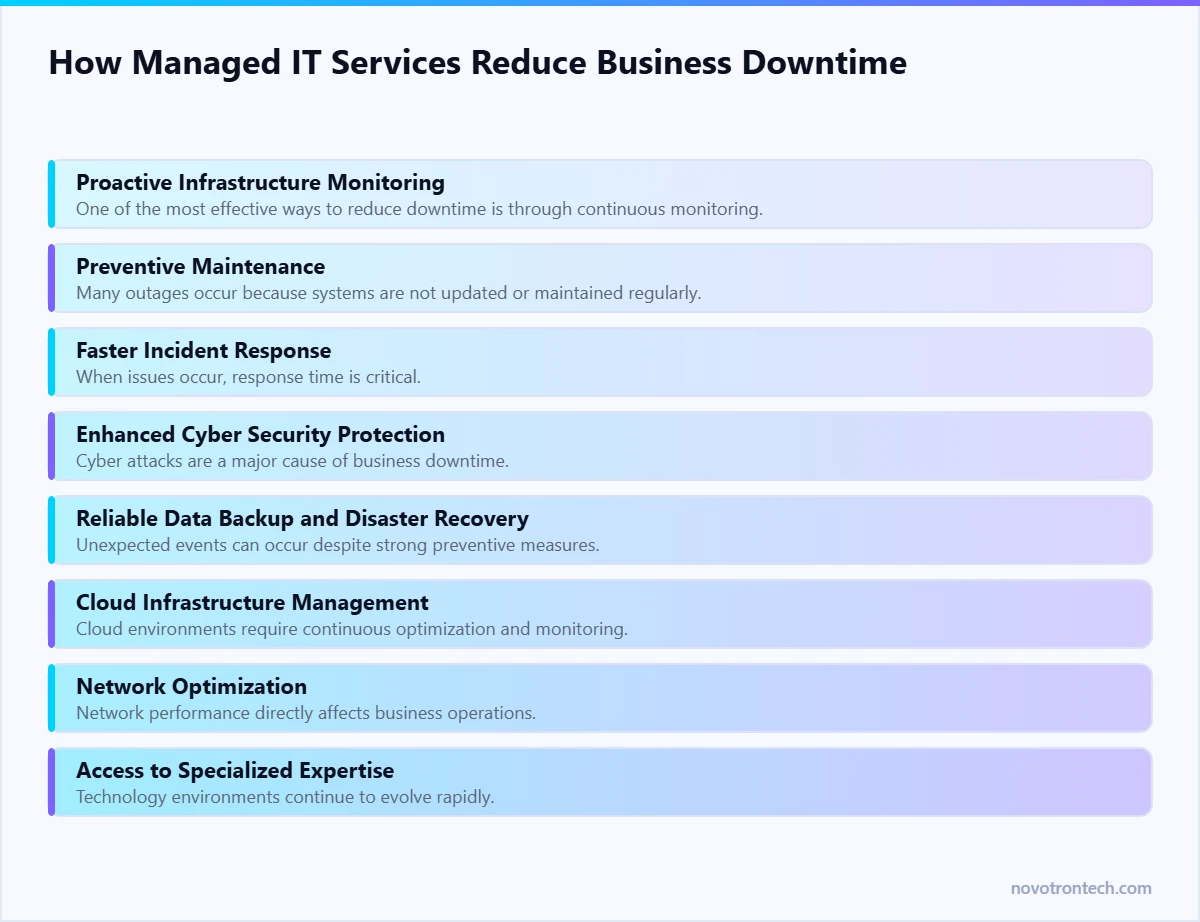
1. Proactive Infrastructure Monitoring
One of the most effective ways to reduce downtime is through continuous monitoring.
Managed IT providers monitor:
- Servers
- Networks
- Endpoints
- Cloud environments
- Applications
Advanced monitoring tools detect unusual activity and performance issues before they escalate into major incidents.
Early detection enables faster resolution and reduces disruption.
2. Preventive Maintenance
Many outages occur because systems are not updated or maintained regularly.
Managed IT teams perform preventive maintenance activities such as:
- Software updates
- Hardware checks
- Patch management
- Configuration reviews
- Capacity planning
Regular maintenance helps organizations avoid avoidable failures.
3. Faster Incident Response
When issues occur, response time is critical.
Managed IT providers offer structured incident response processes that help businesses:
- Identify root causes quickly
- Resolve issues efficiently
- Restore services faster
- Minimize operational impact
Rapid response reduces the duration and severity of disruptions.
4. Enhanced Cyber Security Protection
Cyber attacks are a major cause of business downtime.
Threats such as ransomware, phishing attacks, and malware infections can disrupt operations significantly.
Managed IT services strengthen security through:
- Threat monitoring
- Endpoint protection
- Vulnerability management
- Security updates
- Multi-factor authentication
- Security awareness training
Strong cyber security controls help prevent incidents that lead to downtime.
5. Reliable Data Backup and Disaster Recovery
Unexpected events can occur despite strong preventive measures.
Managed IT providers implement backup and disaster recovery solutions that help organizations:
- Protect critical data
- Recover quickly from incidents
- Maintain business continuity
- Minimize financial impact
Recovery planning ensures businesses can resume operations efficiently.
6. Cloud Infrastructure Management
Cloud environments require continuous optimization and monitoring.
Managed IT services help businesses:
- Monitor cloud performance
- Manage cloud costs
- Strengthen cloud security
- Ensure availability
Well-managed cloud environments improve reliability and reduce downtime risks.
7. Network Optimization
Network performance directly affects business operations.
Managed IT providers monitor and optimize network infrastructure to:
- Reduce latency
- Improve connectivity
- Prevent bottlenecks
- Ensure stable performance
Reliable networks support productivity and customer satisfaction.
8. Access to Specialized Expertise
Technology environments continue to evolve rapidly.
Managed IT providers offer expertise across:
- Infrastructure management
- Cloud technologies
- Cyber security
- Compliance
- Business continuity
Access to experienced professionals helps businesses address complex challenges more effectively.
The Business Impact of Reduced Downtime
Reducing downtime delivers measurable business benefits.
Organizations can:
- Improve employee productivity
- Enhance customer experiences
- Increase operational efficiency
- Reduce financial losses
- Strengthen brand reputation
- Support long-term growth
Reliable technology environments enable businesses to focus on strategic priorities rather than technical issues.
Signs Your Business Needs Managed IT Services
Businesses should consider managed IT services if they experience:
- Frequent outages
- Slow system performance
- Limited IT resources
- Increasing cyber security concerns
- Difficulty managing cloud environments
- Rising technology costs
- Delayed issue resolution
Proactive support helps address these challenges before they affect business performance.
Choosing the Right Managed IT Services Provider
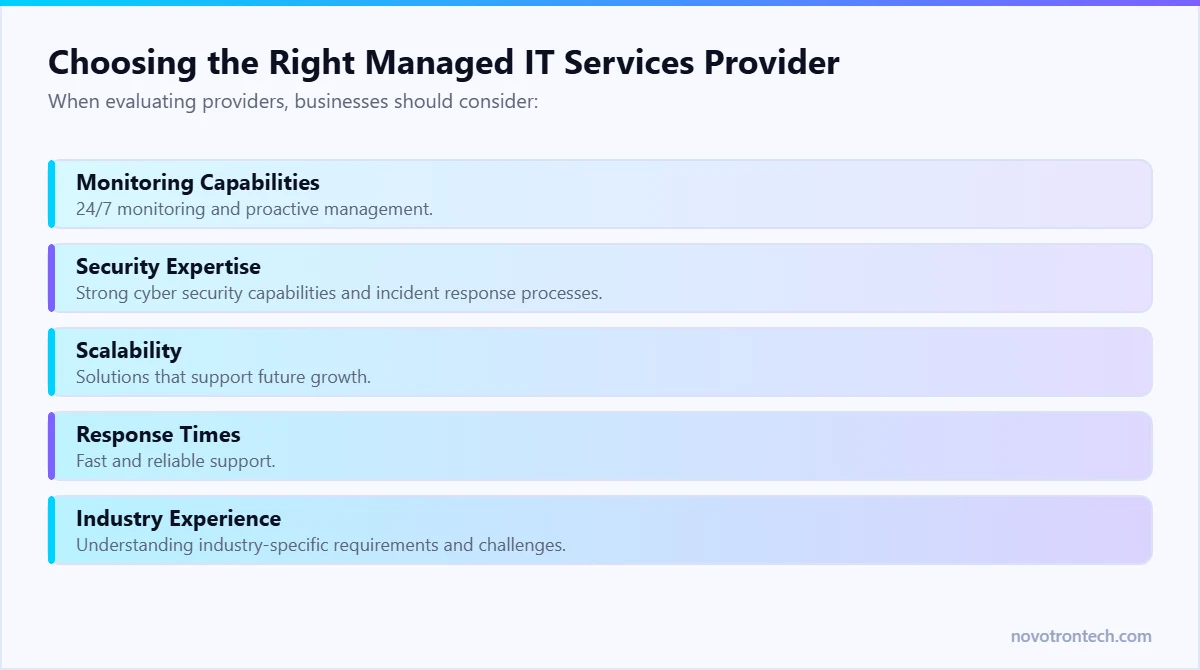
When evaluating providers, businesses should consider:
Monitoring Capabilities
24/7 monitoring and proactive management.
Security Expertise
Strong cyber security capabilities and incident response processes.
Scalability
Solutions that support future growth.
Response Times
Fast and reliable support.
Industry Experience
Understanding industry-specific requirements and challenges.
A trusted technology partner can significantly improve business resilience.
Why Businesses Choose Novotron for Managed IT Services
Growing organizations need more than reactive support.
They need a partner that delivers:
- Continuous infrastructure monitoring
- Cloud management expertise
- Cyber security integration
- Business continuity planning
- Strategic technology guidance
Novotron helps businesses build secure, reliable, and scalable technology environments that reduce downtime and support long-term success.
What Downtime Actually Costs an Indian Mid-Market Business
Downtime is easy to dismiss because the cost is spread across people rather than shown on an invoice. A rough but defensible way to size it: take fully loaded staff cost per hour, multiply by the number of people blocked, add lost transactions for revenue-generating systems, then add the recovery hours your team spends afterwards.
For a 60-person business with an average loaded cost of ₹900 per hour, a four-hour outage affecting half the company costs roughly ₹1,08,000 in idle time alone — before any lost orders, missed SLAs or the two engineers who spend the next day cleaning up. Two such outages a quarter comfortably exceed the annual cost of the monitoring that would have prevented them.
The Four Causes of Most Unplanned Outages
- Change made without a record. A firewall rule, DNS entry or group policy altered directly on production, with nobody able to say what changed when the symptoms appear.
- Capacity reached quietly. A disk fills, a licence count is hit, a certificate expires. All are predictable and all are avoidable with thresholds and a renewal calendar.
- Deferred patching and end-of-support hardware. Systems running past their support date fail in ways nobody has a fix for.
- Security incidents. Ransomware and account compromise now cause more lost days than hardware failure in most estates — which is why endpoint security and monitoring belong in an availability conversation.
How Managed IT Removes Each One
- Change control. Changes are recorded with a rollback plan, so diagnosis starts from a known state instead of guesswork.
- Threshold alerting. Disk, memory, certificate expiry, licence counts and backup failures raise a ticket before users notice — see IT infrastructure monitoring.
- Scheduled patching. A maintenance window and a documented cycle, with compliance reported monthly rather than assumed.
- Lifecycle tracking. Warranty and end-of-support dates tracked against a replacement plan, so hardware is retired before it fails.
- Tested recovery. Backups verified by actual restores against agreed RTO and RPO targets — the difference explained in disaster recovery vs business continuity.
- Out-of-hours coverage. An incident at 11pm gets triaged at 11pm rather than at 9:30 the following morning.
The Availability Numbers to Put in a Contract
Uptime percentages sound reassuring and rarely mean much on their own. What belongs in the agreement is more specific:
- Severity definitions written out, so “critical” is not a matter of opinion during an incident.
- Response and resolution targets per severity, with the coverage window they apply in.
- RTO and RPO per system — how long recovery may take, and how much data may be lost. These drive backup design and cost.
- Patch compliance target, reported monthly with exceptions listed.
- Repeat incident tracking, so root causes get closed rather than symptoms cleared.
If you are still comparing a break-fix arrangement against a managed contract, the cost and coverage differences are set out in IT AMC vs managed IT services.
Conclusion
Business downtime can have serious financial and operational consequences.
Managed IT services help organizations minimize disruptions through proactive monitoring, preventive maintenance, cyber security, cloud management, and disaster recovery planning.
By investing in managed IT services, businesses can improve reliability, strengthen security, enhance productivity, and focus on growth.
Organizations that prioritize proactive technology management are better positioned to thrive in an increasingly digital environment.
FAQs
What are managed IT services?
Managed IT services involve the proactive monitoring, maintenance, and support of business technology infrastructure by an external provider.
How do managed IT services reduce downtime?
Managed IT services reduce downtime through continuous monitoring, preventive maintenance, rapid incident response, and strong cyber security practices.
Why is reducing downtime important for businesses?
Reducing downtime improves productivity, protects revenue, enhances customer experiences, and supports business continuity.
Do managed IT services include disaster recovery?
Yes. Most managed IT providers offer backup and disaster recovery solutions to help businesses recover quickly from disruptions.
Are managed IT services suitable for small businesses?
Yes. Businesses of all sizes can benefit from managed IT services, especially organizations with limited internal IT resources.
Related: managed IT services in Noida — complete guide & pricing · in-house vs managed IT support, honestly compared · our managed IT services.