
Endpoint security protects laptops, desktops, servers, mobile devices, and other connected endpoints from cyber threats. Learn why protection has become essential for businesses in 2026 and how it strengthens your overall cybersecurity strategy.
Modern businesses operate in a highly connected digital environment. Employees work from offices, homes, and remote locations while accessing business applications through laptops, smartphones, tablets, and cloud platforms.
Every connected device becomes a potential entry point for cybercriminals.
As organizations adopt hybrid work models and cloud technologies, the number of endpoints continues to increase. Without proper security controls, these devices can expose sensitive business information and provide attackers with unauthorized access to critical systems.
security helps businesses protect every device connected to their network, reducing cyber risks while supporting productivity and business continuity.
In this guide, we’ll explain whatsecurity is, why it matters, the threats it protects against, and the best practices every organization should follow.
What Is Endpoint Security?
security is the process of protecting devices from cyber threats using securitytechnologies, policies, and continuous monitoring.
Endpoints include:
- Desktop Computers
- Laptops
- Smartphones
- Tablets
- Servers
- Virtual Machines
- Point-of-Sale (POS) Systems
- IoT Devices
- Company-Owned Mobile Devices
Instead of securing only the network perimeter, endpoint security focuses on protecting every individual device that connects to business resources.
This approach is essential because attackers increasingly target endpoints through phishing emails, malware downloads, stolen credentials, and vulnerable software.
Why Endpoint Security Is Important
Every employee device represents a possible attack vector.
If a single laptop becomes infected with ransomware or malware, attackers may gain access to business applications, customer data, cloud environments, and internal systems.
Effective endpoint security helps businesses:
- Prevent unauthorized access
- Detect suspicious activities
- Stop malware infections
- Protect confidential information
- Reduce ransomware risks
- Secure remote work environments
- Improve compliance with security standards
A strong strategy protects both the organization and its users.
Common Endpoint Security Threats
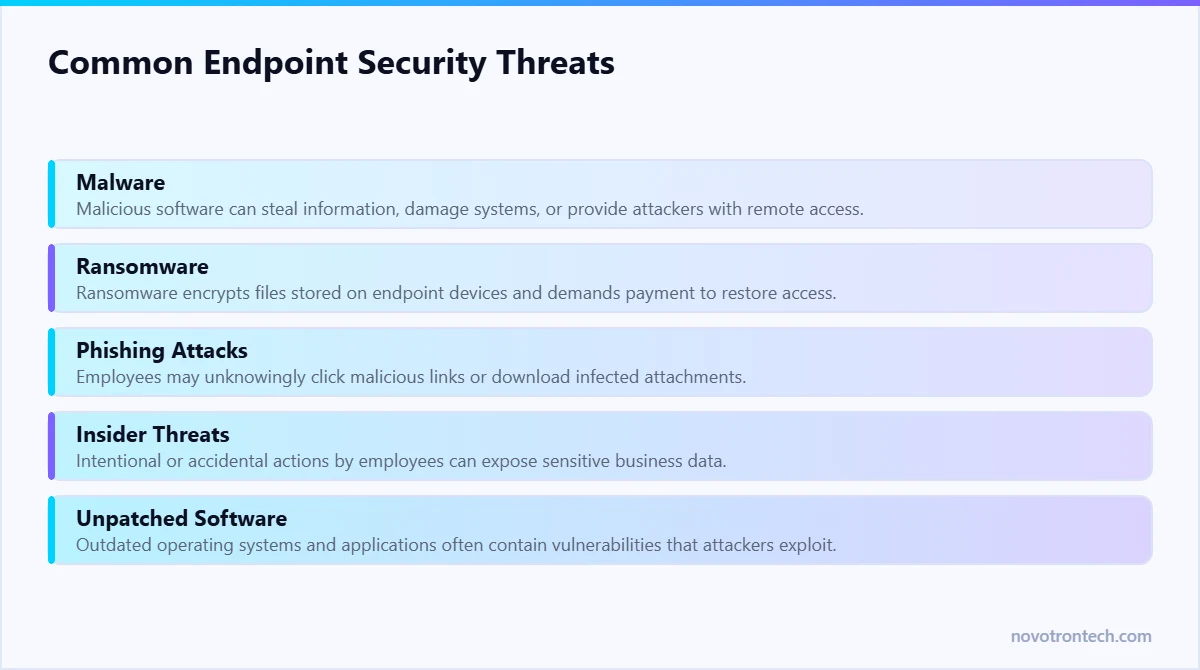
1. Malware
Malicious software can steal information, damage systems, or provide attackers with remote access.
Examples include:
- Viruses
- Worms
- Trojans
- Spyware
- Adware
2. Ransomware
Ransomware encrypts files stored on endpoint devices and demands payment to restore access.
Without proper endpoint protection, a single infected device can impact the entire organization.
3. Phishing Attacks
Employees may unknowingly click malicious links or download infected attachments.
Modern phishing campaigns often target endpoint devices to steal login credentials and install malware.
4. Insider Threats
Intentional or accidental actions by employees can expose sensitive business data.
Endpoint monitoring helps identify unusual behavior before significant damage occurs.
5. Unpatched Software
Outdated operating systems and applications often contain vulnerabilities that attackers exploit.
Regular updates and patch management are essential components.
Key Components of Endpoint Security
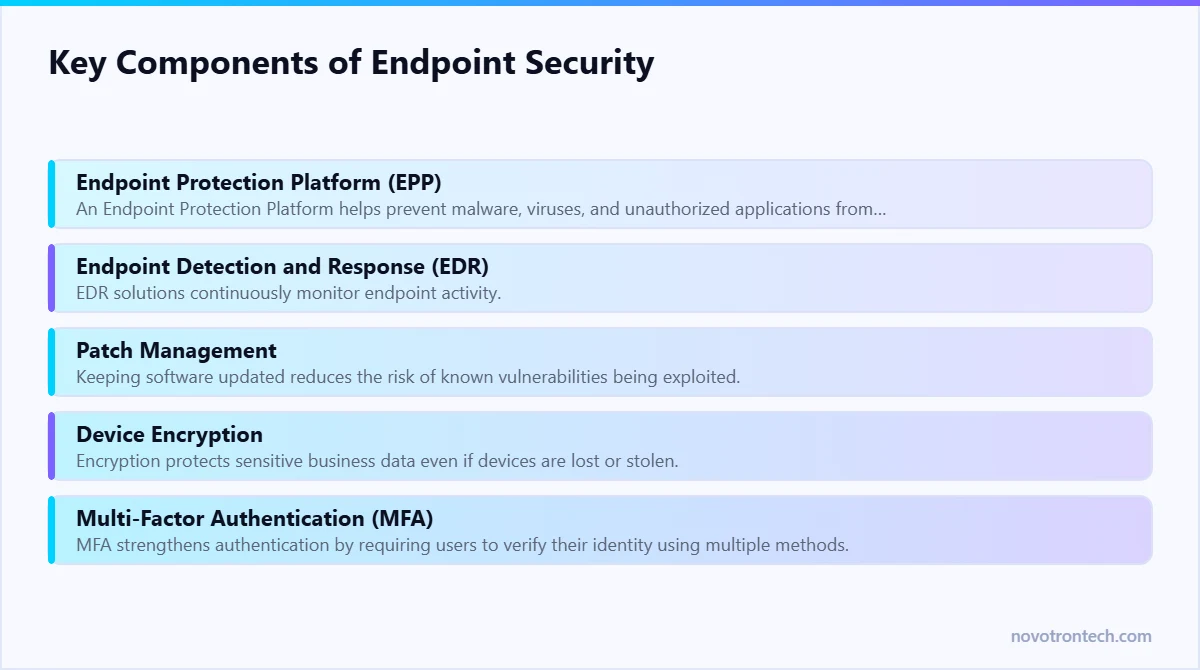
Endpoint Protection Platform (EPP)
An Endpoint Protection Platform helps prevent malware, viruses, and unauthorized applications from compromising devices.
Typical features include:
- Antivirus protection
- Anti-malware tools
- Device control
- Application control
- Web protection
Endpoint Detection and Response (EDR)
EDR solutions continuously monitor endpoint activity.
They help security teams:
- Detect advanced threats
- Investigate suspicious behavior
- Isolate compromised devices
- Respond quickly to incidents
Unlike traditional antivirus software, EDR provides real-time visibility and response capabilities.
Patch Management
Keeping software updated reduces the risk of known vulnerabilities being exploited.
Automated patch management helps maintain a secure endpoint environment.
Device Encryption
Encryption protects sensitive business data even if devices are lost or stolen.
Only authorized users can access encrypted information.
Multi-Factor Authentication (MFA)
MFA strengthens authentication by requiring users to verify their identity using multiple methods.
Even if passwords are compromised, attackers face additional barriers.
Benefits of Endpoint Security
Organizations that invest in experience several advantages.
Improved Protection Against Cyber Attacks
Security solutions identify and block threats before they impact business operations.
Better Visibility
IT teams gain centralized visibility into all connected devices.
Reduced Downtime
Early threat detection minimizes disruptions caused by malware and ransomware.
Enhanced Compliance
helps organizations meet industry regulations and data protection requirements.
Secure Remote Work
Employees can safely access business resources from any location.
Best Practices for Endpoint Security
Businesses should adopt the following practices:
- Deploy advanced endpoint protection solutions
- Enable Endpoint Detection and Response (EDR)
- Enforce Multi-Factor Authentication
- Keep operating systems and software updated
- Conduct regular Vulnerability Assessment and Penetration Testing (VAPT)
- Monitor endpoint activity continuously
- Restrict user permissions based on job roles
- Encrypt sensitive business data
- Train employees to recognize phishing attempts
- Maintain secure backup and recovery processes
A layered security approach significantly improves protection.
Endpoint Security and Zero Trust
Modern security strategies increasingly adopt a Zero Trust approach.
Zero Trust assumes that no device or user should be trusted automatically.
Every access request is verified before granting access to business resources.
Endpoint security is a critical component of a Zero Trust architecture because it continuously validates the health and security status of connected devices.
How Endpoint Security Supports Digital Transformation
As businesses adopt cloud computing, AI-powered applications, and hybrid work environments, endpoint protection becomes even more important.
Secure endpoints allow organizations to:
- Expand remote work securely
- Protect cloud applications
- Improve operational resilience
- Enable digital innovation
- Reduce business risks
Endpoint security supports both productivity and cyber resilience.
Why Businesses Choose Novotron for Endpoint Security
Protecting endpoint devices requires more than traditional antivirus software.
Novotron helps businesses strengthen endpoint security through:
- Endpoint Protection Solutions
- Endpoint Detection & Response (EDR)
- Security Monitoring
- Vulnerability Assessment & Penetration Testing (VAPT)
- Security Operations Center (SOC) Support
- IT Infrastructure Management
- Cloud Security Services
By combining proactive monitoring with advanced threat detection, Novotron helps organizations secure every endpoint and reduce cyber risks.
Antivirus, EPP, EDR and XDR: What the Acronyms Actually Mean
Vendors use these terms loosely, and the difference decides whether you can investigate an incident or only hope it was blocked.
- Antivirus / EPP (endpoint protection platform). Prevention. Signature and behaviour-based blocking of known-bad files and actions. Stops commodity malware; leaves no useful trail when something novel gets through.
- EDR (endpoint detection and response). Records process execution, network connections, registry and file changes, then lets an analyst search that history, isolate a host and roll back changes. This is what makes an investigation possible.
- XDR (extended detection and response). EDR telemetry correlated with identity, email, cloud and network signals, so a suspicious login and a suspicious process are seen as one incident.
- MDR (managed detection and response). Any of the above with humans watching around the clock. The tooling is only half the control — see managed detection and response.
The practical rule: EPP without EDR means you will know something was blocked but not what happened when something was not. EDR without anyone monitoring it means the evidence exists and nobody looks at it.
Endpoint Hardening That Costs Nothing
Before buying a tool, close the gaps that tooling has to work around.
- Remove local administrator rights from standard users. This single change blocks a large share of malware execution paths.
- Enable full-disk encryption on every laptop, with recovery keys escrowed centrally. A lost device becomes an inconvenience rather than a data breach.
- Enforce automatic OS and browser updates with a deadline, not a prompt users can defer indefinitely.
- Turn on host firewalls and block inbound connections between workstations.
- Control USB and removable media — read-only by default is usually workable.
- Disable Office macros from the internet, still one of the most reliable delivery routes.
BYOD and Personal Devices
Most Indian mid-market businesses have some personal-device access to company email or files, whether or not policy allows it. Pretending otherwise is the risk. Two workable positions exist: enrol personal devices into management with a clear boundary between work and personal data, or allow access only through browser-based sessions with no data stored locally and conditional access enforcing MFA and device checks. What does not work is unmanaged devices with full mail and file synchronisation.
Endpoint Security and Ransomware Recovery
Endpoint controls reduce the chance of ransomware executing; they do not remove the need to recover from it. The two work together: EDR gives you the timeline of what was touched and when, and backups give you the data. Recovery planning fails most often because the backup infrastructure is reachable from the same network as the infected endpoints. Keep at least one copy offline or immutable, test restores on a schedule, and record the date of the last successful test — the reasoning is set out in backup as a service and disaster recovery vs business continuity.
Conclusion
As businesses continue to embrace digital transformation, the number of connected devices will only increase.
Each endpoint represents a potential target for cybercriminals, making endpoint security an essential part of every organization’s cyber security strategy.
By implementing endpoint protection, EDR, patch management, and strong authentication controls, businesses can reduce risks, improve resilience, and maintain secure operations.
Investing in endpoint security today helps protect business continuity, customer trust, and long-term growth.
FAQs
What is endpoint security?
Endpoint security protects devices such as laptops, desktops, mobile phones, and servers from cyber threats using advanced security technologies.
Why is endpoint security important?
It helps prevent malware, ransomware, phishing attacks, unauthorized access, and data breaches while supporting secure business operations.
What is the difference between antivirus and endpoint security?
Antivirus focuses mainly on detecting known malware. provides broader protection, including device management, EDR, monitoring, encryption, and threat response.
What is EDR?
Endpoint Detection and Response (EDR) continuously monitors devices, detects suspicious behavior, and helps security teams respond to advanced cyber threats.
Which businesses need endpoint security?
Organizations of all sizes, especially those using cloud services, remote work, or handling sensitive customer and business data.
Related: what VAPT & SOC monitoring actually cost in Noida · 24/7 SOC support services · how to choose an IT partner in Noida.