
Every business today depends on a reliable and secure network. Employees access cloud applications, customers interact through online platforms, and business operations rely on connected devices and digital systems. While this connectivity improves efficiency, it also increases the risk of cyber threats.
Cybercriminals constantly look for vulnerabilities in business networks to steal sensitive information, disrupt operations, or deploy ransomware. Even a single security incident can result in financial losses, reputational damage, regulatory penalties, and downtime.
This is why network security has become one of the most critical components of modern IT infrastructure. Whether you are a startup, an SME, or a large enterprise, protecting your network is essential for maintaining business continuity and customer trust.
In this guide, we explain what network security is, why it matters, the common threats businesses face, and the best practices for building a secure network.
What Is Network Security?
Network security refers to the technologies, policies, processes, and controls designed to protect computer networks, connected devices, and data from unauthorized access, cyber attacks, and misuse.
It includes securing:
- Local Area Networks (LAN)
- Wide Area Networks (WAN)
- Wireless Networks (Wi-Fi)
- Cloud Networks
- Remote Access Connections
- Business Applications
- Connected Endpoints
The primary objective of network security is to ensure the confidentiality, integrity, and availability (CIA) of business data and systems.
Why Network Security Is Important for Businesses
A secure network is no longer optional—it is a business necessity. As organizations adopt cloud computing, hybrid work models, and digital transformation initiatives, the number of potential entry points for attackers continues to grow.
Strong network security helps businesses:
- Prevent unauthorized access to sensitive data
- Protect customer and employee information
- Reduce the risk of ransomware and malware attacks
- Maintain business continuity
- Support regulatory compliance
- Minimize financial and reputational damage
- Enable secure remote work
Without proper protection, even a minor vulnerability can lead to significant operational disruptions.
Common Network Security Threats
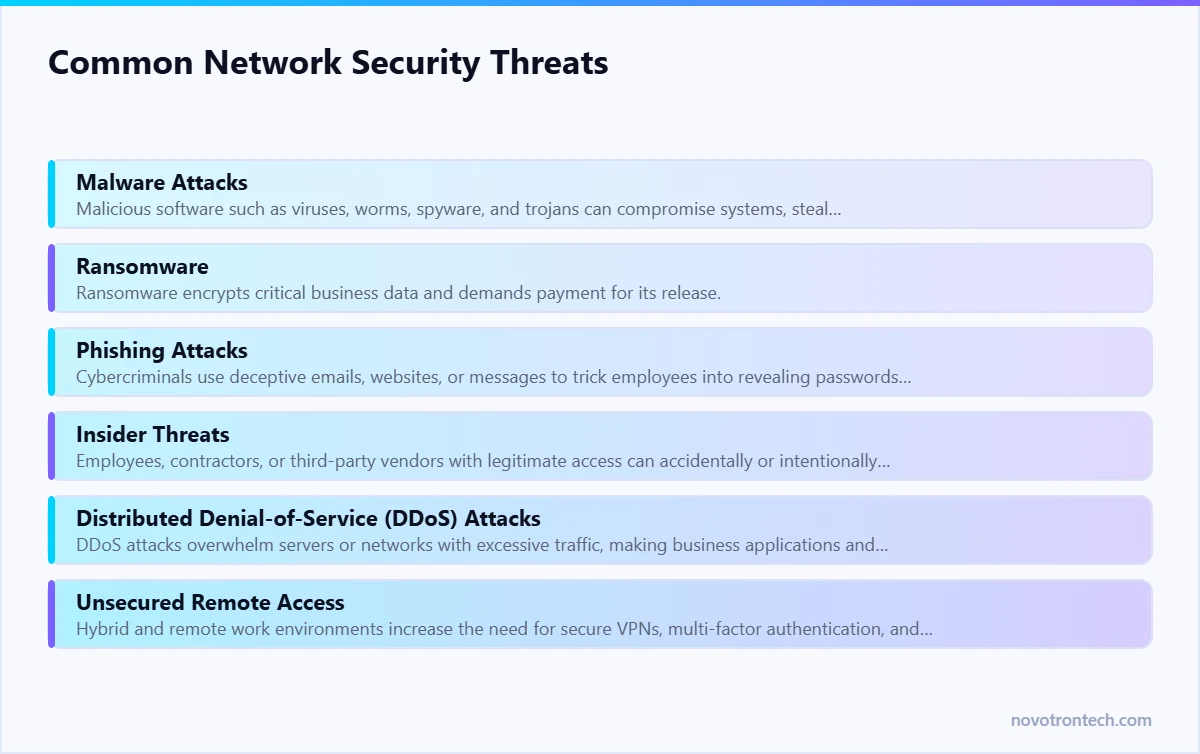
1. Malware Attacks
Malicious software such as viruses, worms, spyware, and trojans can compromise systems, steal information, or damage business operations.
2. Ransomware
Ransomware encrypts critical business data and demands payment for its release. These attacks can halt operations and cause severe financial losses.
3. Phishing Attacks
Cybercriminals use deceptive emails, websites, or messages to trick employees into revealing passwords or downloading malicious files.
4. Insider Threats
Employees, contractors, or third-party vendors with legitimate access can accidentally or intentionally expose sensitive business information.
5. Distributed Denial-of-Service (DDoS) Attacks
DDoS attacks overwhelm servers or networks with excessive traffic, making business applications and websites unavailable to legitimate users.
6. Unsecured Remote Access
Hybrid and remote work environments increase the need for secure VPNs, multi-factor authentication, and encrypted connections.
Essential Components of Network Security
A comprehensive network security strategy includes multiple layers of protection.
Firewalls
Firewalls monitor and control incoming and outgoing network traffic based on predefined security rules.
Intrusion Detection and Prevention Systems (IDS/IPS)
These systems identify suspicious activities and automatically block potential threats before they cause damage.
Multi-Factor Authentication (MFA)
MFA adds an extra layer of security by requiring users to verify their identity using multiple authentication methods.
Endpoint Security
Protects laptops, desktops, smartphones, and servers from malware and unauthorized access.
Network Access Control (NAC)
Ensures that only authorized users and devices can access the business network.
Virtual Private Networks (VPNs)
VPNs encrypt internet traffic, enabling secure remote access for employees.
Security Monitoring
Continuous monitoring helps detect unusual behavior and respond to threats in real time.
Benefits of Strong Network Security
Businesses that invest in network security gain several long-term advantages.
Improved Data Protection
Sensitive customer, financial, and business information remains protected from unauthorized access.
Reduced Downtime
Proactive security measures help prevent attacks that could disrupt operations.
Regulatory Compliance
Strong network security supports compliance with industry regulations and data protection requirements.
Enhanced Customer Trust
Customers are more likely to engage with businesses that demonstrate a commitment to protecting their information.
Better Business Continuity
Reliable network security minimizes operational disruptions and improves resilience.
Best Practices for Network Security
To strengthen network security, businesses should:
- Implement strong password policies
- Enable multi-factor authentication
- Keep systems and software updated
- Conduct regular Vulnerability Assessment and Penetration Testing (VAPT)
- Monitor network activity continuously
- Encrypt sensitive data
- Train employees to recognize phishing attacks
- Back up critical business data regularly
- Limit user access based on roles
- Develop an incident response plan
A proactive approach is more effective than reacting after a security breach occurs.
How Network Security Supports Digital Transformation
Digital transformation introduces new technologies such as cloud computing, IoT devices, artificial intelligence, and remote collaboration tools.
While these technologies improve efficiency, they also increase the attack surface.
Network security enables organizations to adopt innovation confidently by protecting digital assets, ensuring secure connectivity, and maintaining operational stability.
Why Businesses Choose Novotron for Network Security
Protecting modern business networks requires expertise, continuous monitoring, and a proactive security strategy.
Novotron helps organizations strengthen their security posture through:
- Network Security Assessments
- Firewall Configuration and Management
- Security Monitoring
- Vulnerability Assessment & Penetration Testing (VAPT)
- Security Operations Center (SOC) Support
- Cloud Security Solutions
- IT Infrastructure Management
By combining advanced technologies with industry best practices, Novotron helps businesses build secure, scalable, and resilient network environments.
Network Security in a Perimeter-Free Environment
The traditional model assumed a trusted inside and a hostile outside, with a firewall between them. Remote work, SaaS and cloud workloads have removed most of that boundary. Staff connect from home networks, data sits in applications you do not host, and a compromised laptop is already inside whatever perimeter remains.
The modern equivalent is to stop treating network location as proof of trust. Every access request is authenticated, authorised against the specific resource, and evaluated on device posture rather than on which subnet it came from. That is the practical core of Zero Trust security, and it is a design principle rather than a product you buy.
Network Segmentation: The Highest-Value Control Most Businesses Skip
Segmentation is what turns a breach into an incident rather than a catastrophe. When everything sits on one flat network, a single compromised endpoint can reach the file server, the finance system, the backup target and the CCTV recorder. When the network is segmented, the attacker has to break through again at each boundary, and each attempt is something monitoring can catch.
- Separate user devices from servers. Workstations rarely need direct access to server management interfaces.
- Isolate operational technology. Plant equipment, building systems and cameras belong on their own segment with tightly defined routes.
- Give guests and IoT their own VLAN with no route to internal resources.
- Protect the backup network. If ransomware can reach backups from a user workstation, backups are not a recovery plan.
- Restrict management traffic to a dedicated segment reachable only through a jump host with MFA.
The Controls Worth Having, in Priority Order
- Multi-factor authentication on VPN, remote access, cloud consoles and email — the single highest-return control available. See why MFA is essential.
- Patched, supported edge devices. Firewalls and VPN appliances are among the most exploited entry points precisely because they are internet-facing and often forgotten.
- Segmentation as described above.
- Endpoint detection and response on every device, because the endpoint is now the real perimeter — covered in endpoint security.
- Centralised logging from firewalls, servers and identity systems, retained long enough to investigate. Without logs, an incident becomes speculation. See SIEM.
- Monitoring with someone watching. Alerts nobody triages at 3am are not a control — this is what SOC support provides.
How to Verify Your Network Security Is Real
Assume nothing works until it has been tested. Four checks give you an honest picture without a large budget:
- List everything internet-facing. Every open port, every published service, every remote access route. Most estates find something nobody remembered exposing.
- Check edge device firmware against current versions and end-of-support dates.
- Attempt lateral movement from a standard user workstation to a server management interface. If it succeeds, segmentation is the priority.
- Commission a scoped network VAPT and fix findings in severity order, with a retest to prove closure.
Conclusion
Network security is one of the most important investments a business can make. As cyber threats become more sophisticated, protecting networks, applications, and sensitive data requires a comprehensive security strategy.
By implementing layered security controls, educating employees, monitoring network activity, and partnering with experienced IT security providers, organizations can significantly reduce cyber risks and ensure business continuity.
Whether your business is expanding its cloud infrastructure, supporting remote teams, or modernizing IT systems, network security should remain a top priority.
FAQs
What is network security?
Network security is the practice of protecting computer networks, devices, and data from unauthorized access, cyber attacks, and other security threats.
Why is network security important?
It protects business data, prevents cyber attacks, reduces downtime, and helps organizations maintain compliance with industry regulations.
What are the biggest network security threats?
Common threats include ransomware, phishing attacks, malware, insider threats, DDoS attacks, and unauthorized access.
How can businesses improve network security?
Businesses can strengthen network security through firewalls, multi-factor authentication, regular software updates, continuous monitoring, employee training, and routine VAPT assessments.
Is network security only for large enterprises?
No. Businesses of all sizes need network security because cybercriminals often target small and medium-sized organizations with weaker defenses.
Related: what VAPT & SOC monitoring actually cost in Noida · 24/7 SOC support services · how to choose an IT partner in Noida.