
Cyber threats are evolving faster than ever. Businesses of all sizes now depend on digital systems, cloud infrastructure, remote work environments, and connected applications to operate efficiently. While technology creates opportunities for growth, it also increases exposure to cyber risks.
In 2026, organizations face ransomware attacks, phishing campaigns, data breaches, insider threats, and sophisticated malware attacks on a daily basis. A single security incident can disrupt operations, damage customer trust, and create significant financial losses.
This is why cyber security is no longer optional. It has become a critical business requirement.
The Growing Cyber Threat Landscape
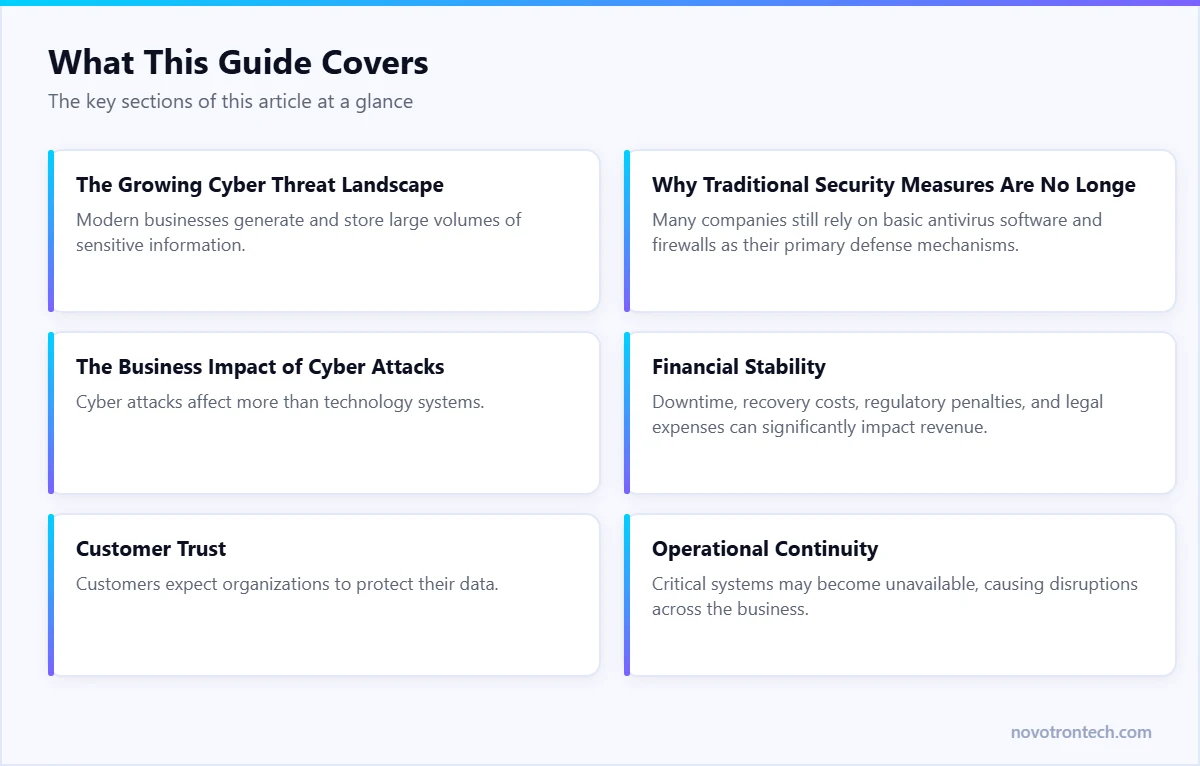
Modern businesses generate and store large volumes of sensitive information. Customer records, financial data, intellectual property, employee information, and operational systems are all valuable targets for cybercriminals.
Attackers are using automation, artificial intelligence, and advanced attack techniques to exploit vulnerabilities faster than ever before.
Common threats include:
- Ransomware attacks
- Phishing campaigns
- Credential theft
- Insider threats
- Cloud security misconfigurations
- Supply chain attacks
- Data breaches
Organizations that lack proactive security measures often discover vulnerabilities only after a successful attack has occurred.
Why Traditional Security Measures Are No Longer Enough
Many companies still rely on basic antivirus software and firewalls as their primary defense mechanisms.
Unfortunately, modern cyber threats can bypass traditional security controls.
Today’s businesses require:
- Continuous monitoring
- Threat detection
- Vulnerability assessments
- Security awareness training
- Incident response planning
- Endpoint protection
- Cloud security management
A layered security strategy provides stronger protection against emerging threats.
The Business Impact of Cyber Attacks
Cyber attacks affect more than technology systems.
They impact:
Financial Stability
Downtime, recovery costs, regulatory penalties, and legal expenses can significantly impact revenue.
Customer Trust
Customers expect organizations to protect their data. A breach can damage brand reputation for years.
Operational Continuity
Critical systems may become unavailable, causing disruptions across the business.
Regulatory Compliance
Businesses must comply with industry regulations and security standards. Security incidents can create compliance challenges and financial penalties.
Benefits of Professional Cyber Security Services
1. Proactive Threat Monitoring
Professional cyber security teams continuously monitor systems for suspicious activity and potential threats.
Early detection helps reduce risk and minimize damage.
2. Vulnerability Identification
Regular vulnerability assessments and penetration testing help identify weaknesses before attackers can exploit them.
3. Incident Response Preparedness
Security experts develop response plans that enable organizations to react quickly during security incidents.
4. Stronger Data Protection
Advanced security controls help protect sensitive business and customer information.
5. Improved Compliance
Cyber security services help organizations align with security frameworks, compliance requirements, and industry best practices.
Key Cyber Security Services Every Business Should Consider
Security Operations Center (SOC)
Continuous monitoring and threat detection.
Vulnerability Assessment & Penetration Testing (VAPT)
Identifying security weaknesses before attackers find them.
Dark Web Monitoring
Detecting exposed credentials and compromised business information.
Security Hardening
Strengthening systems, applications, and infrastructure.
Compliance Audits
Evaluating security controls and governance practices.
Phishing Simulation Programs
Improving employee awareness and reducing human risk.
How Cyber Security Supports Business Growth
Many business leaders view cyber security as a cost.
In reality, cyber security supports growth by:
- Increasing customer confidence
- Protecting digital assets
- Enabling secure cloud adoption
- Supporting remote work environments
- Reducing operational risks
- Improving business continuity
Organizations with strong security foundations are better positioned to scale confidently.
Choosing the Right Cyber Security Partner
When evaluating cyber security providers, businesses should consider:
- Industry experience
- Security certifications
- Monitoring capabilities
- Incident response expertise
- Compliance knowledge
- Scalability
- Reporting and visibility
A trusted partner helps businesses stay ahead of evolving cyber threats while supporting long-term growth objectives.
What Cyber Security Services Actually Cost in India
Cost is the question that stalls most security programmes, usually because quotes are impossible to compare. Two proposals labelled “VAPT” can differ by a factor of ten because one is an automated scan and the other is manual testing by a senior consultant. Before you compare prices, make the vendors quote the same scope.
As a working set of 2026 benchmarks for Delhi NCR:
- Web application VAPT — roughly ₹35,000 to ₹1,50,000 per application, depending on the number of user roles, integrations and whether a retest is included.
- Network VAPT — roughly ₹50,000 to ₹3,00,000, driven mainly by live IP count and whether internal testing is in scope.
- Managed SOC monitoring — roughly ₹50,000 to ₹2,00,000+ per month, priced on endpoints, users or log volume ingested.
- Security gap assessment — a documentation and controls review, usually the cheapest entry point and the sensible first purchase.
Detailed breakdowns of each of these sit in our pricing guides: VAPT cost in India, SOC as a Service pricing and cyber security audit cost. If you are comparing providers rather than budgets, the best cyber security companies in Noida list explains what separates them.
The DPDP Act Has Changed the Risk Calculation
Until recently, the business case for security in India was built on avoided downtime and reputational damage. That changed with the Digital Personal Data Protection Act. The DPDP Rules were notified in November 2025 and the compliance runway closes in May 2027, which means most of the obligations that IT teams own — knowing what personal data you hold, capturing consent, honouring data principal rights, notifying breaches and enforcing retention limits — need working systems behind them, not policy documents.
The penalty ceiling for failing to take reasonable security safeguards runs to ₹250 crore. For a mid-sized business that number is not the realistic exposure, but it does change how a board reads a security proposal. Security spending stopped being discretionary the moment non-compliance acquired a price tag. Our DPDP Act compliance checklist sets out what IT specifically has to deliver and in what order.
Signs Your Business Has Outgrown Basic Security
Antivirus and a firewall are not a security programme; they are two controls inside one. The practical question is whether your current setup can answer three things: what happened, when it happened, and what you did about it. Most businesses discover they cannot when they are asked by an auditor or a customer.
It is usually time to bring in professional cyber security services when any of the following is true:
- Nobody is looking at security alerts outside office hours, and nobody is accountable for them during office hours either.
- Your team cannot produce a current list of internet-facing systems, admin accounts or third-party integrations.
- Patching happens when someone remembers, not on a schedule you could evidence.
- A customer, insurer or investor has asked for a VAPT report, an ISO 27001 certificate or a security questionnaire you could not complete.
- You have moved workloads to the cloud without changing who reviews access and configuration.
- You hold personal data on Indian residents and have no defined breach notification process.
A Realistic First 90 Days
Security programmes fail when they start with tooling. The sequence that works starts with visibility, then control, then monitoring.
- Weeks 1–3 — establish the baseline. Inventory endpoints, servers, cloud tenants, SaaS applications and privileged accounts. Run a gap assessment against a recognised framework so later work has a reference point.
- Weeks 4–6 — close the obvious exposure. Enforce multi-factor authentication, remove dormant and shared accounts, patch internet-facing systems, and confirm backups actually restore.
- Weeks 7–10 — test rather than assume. Commission a scoped VAPT on the assets that matter most, and fix findings in severity order with a retest to prove closure.
- Weeks 11–13 — turn on monitoring. Start SOC support or managed detection so alerts are triaged around the clock, and agree escalation paths before you need them.
That order matters. Monitoring an environment you have not inventoried produces alerts nobody can act on, and testing an environment with unpatched basics produces a report full of findings you already knew about.
Conclusion
Cyber threats will continue to grow in complexity throughout 2026 and beyond. Businesses that invest in proactive cyber security services can significantly reduce risk, protect critical assets, and maintain operational resilience.
Cyber security is no longer simply an IT responsibility. It is a business priority that directly impacts trust, growth, compliance, and long-term success.
Organizations that strengthen their security posture today will be better prepared for the challenges of tomorrow.
Thats Why Businesses Need Cyber Security Services in 2026
FAQs
Why Businesses Need Cyber Security Services in 2026?
Cyber security services help protect organizations from cyber attacks, data breaches, ransomware, and operational disruptions.
What is VAPT in cyber security?
Vulnerability Assessment and Penetration Testing (VAPT) helps identify and validate security weaknesses within systems and applications.
How does SOC monitoring improve security?
SOC monitoring provides continuous visibility into security events, enabling faster detection and response to threats.
Can small businesses benefit from cyber security services?
Yes. Small businesses are frequently targeted by cybercriminals and can benefit significantly from proactive security measures.
How often should businesses perform security assessments?
Most organizations should perform regular assessments at least annually, with additional testing after significant infrastructure changes.
Related: what VAPT & SOC monitoring actually cost in Noida · 24/7 SOC support services · how to choose an IT partner in Noida.