Cyber threats are becoming more sophisticated every year. Businesses now face constant risks from ransomware attacks, phishing campaigns, insider threats, malware infections, data breaches, and advanced persistent threats.
While firewalls, antivirus software, and endpoint security solutions are important, they are no longer enough on their own.
Organizations need continuous monitoring, real-time threat detection, rapid incident response, and proactive security management to stay protected.
This is where SOC Support plays a critical role.
A Security Operations Center (SOC) acts as the central hub for monitoring, detecting, investigating, and responding to cyber threats across an organization’s IT environment.
Businesses that invest in SOC Support can identify threats earlier, reduce response times, strengthen security defenses, and minimize the impact of cyber attacks.
What Is SOC Support?
SOC stands for Security Operations Center.
SOC Support refers to the continuous monitoring, analysis, detection, and response activities performed by security professionals to protect an organization’s systems, networks, applications, and data.
The primary objective of SOC Support is to identify suspicious activity before it becomes a serious security incident.
A SOC operates 24/7 and continuously monitors security events across the organization’s technology infrastructure.
SOC teams use advanced security tools, threat intelligence, and security expertise to investigate and respond to potential threats.
Why Modern Businesses Need SOC Support
Cyber attacks can occur at any time.
Attackers do not operate only during business hours.
Threats can emerge during weekends, holidays, or late at night when internal IT teams may not be actively monitoring systems.
Businesses today face risks such as:
- Ransomware attacks
- Phishing campaigns
- Credential theft
- Insider threats
- Malware infections
- Cloud security incidents
- Data breaches
- Unauthorized access attempts
Without continuous monitoring, organizations may not detect threats until significant damage has already occurred.
SOC Support helps close this visibility gap.
How Does a Security Operations Center Work?
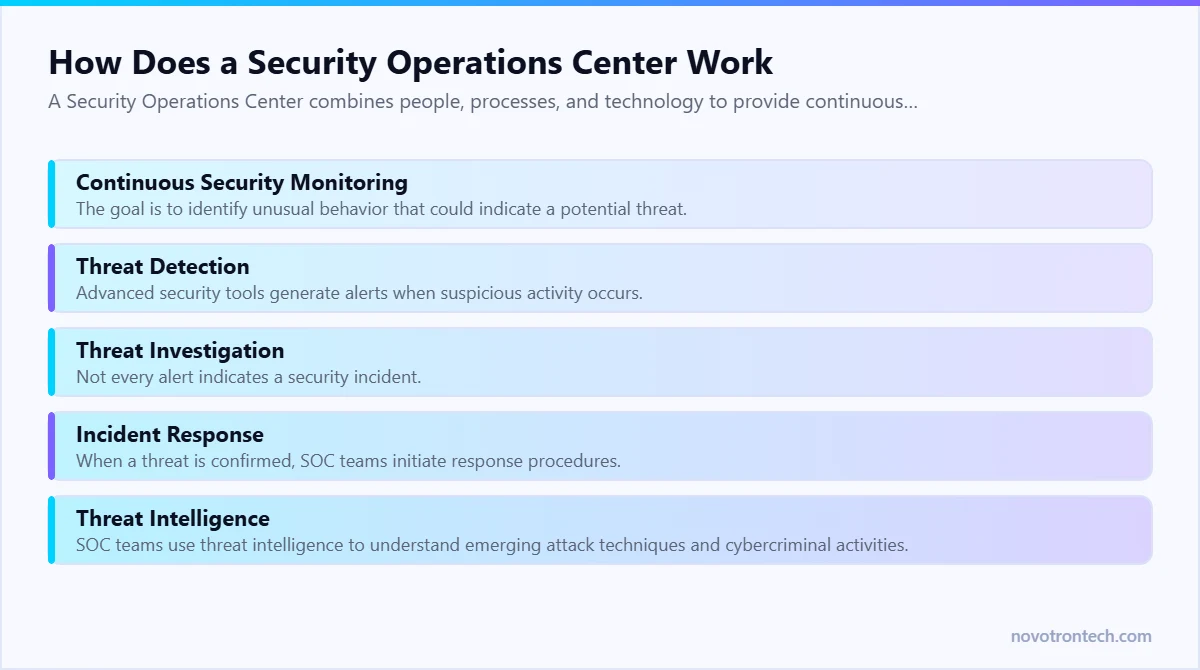
A Security Operations Center combines people, processes, and technology to provide continuous security monitoring and incident response.
SOC operations typically involve several key functions.
Continuous Security Monitoring
SOC analysts monitor:
- Networks
- Servers
- Endpoints
- Cloud environments
- Applications
- Security devices
The goal is to identify unusual behavior that could indicate a potential threat.
Continuous monitoring enables faster detection and response.
Threat Detection
Advanced security tools generate alerts when suspicious activity occurs.
Examples include:
- Failed login attempts
- Unusual network traffic
- Malware activity
- Privilege escalation attempts
- Unauthorized access attempts
SOC teams investigate these alerts to determine whether they represent genuine threats.
Threat Investigation
Not every alert indicates a security incident.
SOC analysts investigate suspicious activity by:
- Reviewing logs
- Analyzing user behavior
- Examining threat indicators
- Correlating security events
This process helps separate legitimate activity from actual threats.
Incident Response
When a threat is confirmed, SOC teams initiate response procedures.
Response activities may include:
- Isolating affected systems
- Blocking malicious traffic
- Removing malware
- Containing security incidents
- Coordinating remediation efforts
Rapid response helps reduce business impact.
Threat Intelligence
SOC teams use threat intelligence to understand emerging attack techniques and cybercriminal activities.
Threat intelligence provides valuable context that improves threat detection and response effectiveness.
Key Components of SOC Support Services
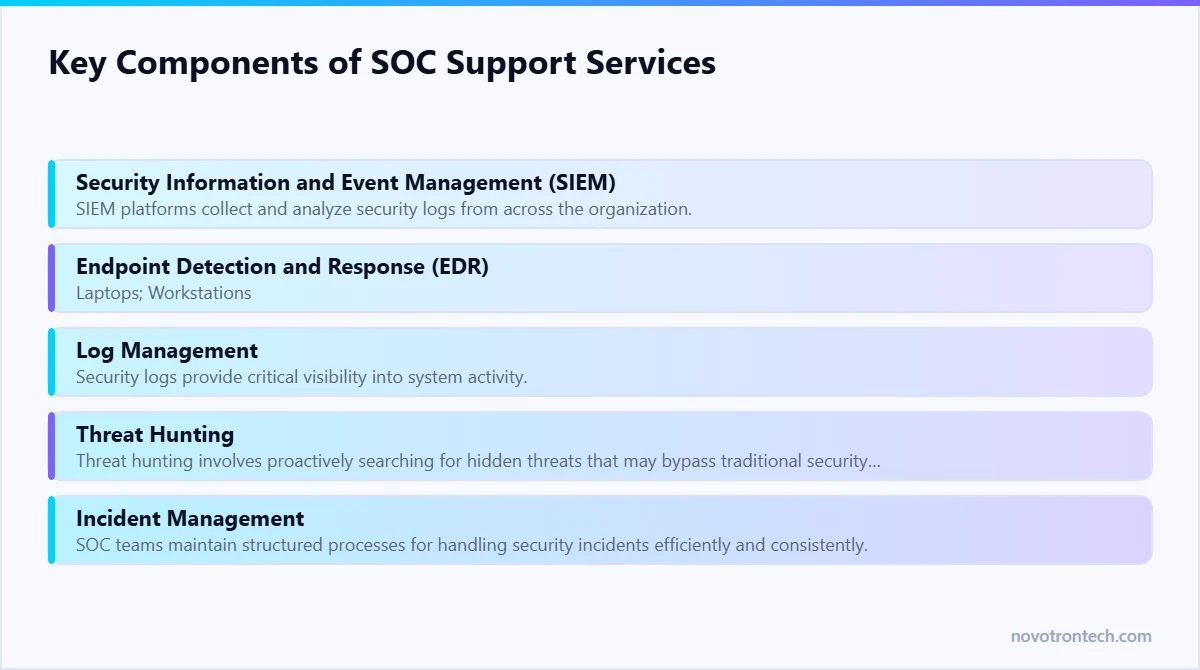
Security Information and Event Management (SIEM)
SIEM platforms collect and analyze security logs from across the organization.
These systems help identify suspicious patterns and generate alerts for investigation.
Endpoint Detection and Response (EDR)
EDR solutions monitor devices such as:
- Laptops
- Workstations
- Servers
- Mobile devices
These tools help detect malicious activity at the endpoint level.
Log Management
Security logs provide critical visibility into system activity.
SOC teams analyze logs to identify indicators of compromise and potential threats.
Threat Hunting
Threat hunting involves proactively searching for hidden threats that may bypass traditional security controls.
This approach helps organizations identify advanced attacks before they cause significant damage.
Incident Management
SOC teams maintain structured processes for handling security incidents efficiently and consistently.
Benefits of SOC Support for Businesses
1. 24/7 Security Monitoring
Threats can emerge at any time.
SOC Support provides around-the-clock monitoring that helps organizations detect threats regardless of when they occur.
2. Faster Threat Detection
Early detection significantly reduces the impact of cyber attacks.
SOC teams identify suspicious activity before attackers can achieve their objectives.
3. Improved Incident Response
A rapid response can prevent minor incidents from becoming major security breaches.
SOC teams follow established procedures to contain and remediate threats efficiently.
4. Reduced Business Risk
Continuous monitoring reduces the likelihood of successful cyber attacks and minimizes potential business disruption.
5. Enhanced Compliance
Many compliance frameworks require continuous monitoring and security oversight.
SOC Support helps organizations strengthen governance and compliance readiness.
6. Better Visibility Across Infrastructure
SOC teams provide centralized visibility across:
- Networks
- Applications
- Endpoints
- Cloud environments
- Security systems
This visibility improves overall security management.
Common Threats Identified by SOC Teams
SOC analysts regularly detect and investigate:
Ransomware Attacks
Preventing malware from encrypting critical business data.
Phishing Attempts
Identifying malicious emails and credential theft attempts.
Insider Threats
Detecting unauthorized activities by internal users.
Account Compromise
Monitoring suspicious login behavior and unauthorized access attempts.
Malware Infections
Identifying malicious software before it spreads across the environment.
Data Exfiltration Attempts
Detecting attempts to steal sensitive information.
SOC Support vs Traditional IT Monitoring
Many organizations assume IT monitoring and SOC monitoring are the same.
However, they serve different purposes.
Traditional IT Monitoring Focuses On:
- System uptime
- Infrastructure performance
- Network availability
- Service health
SOC Monitoring Focuses On:
- Threat detection
- Security incidents
- Cyber attacks
- Threat intelligence
- Incident response
Both functions are important, but SOC Support specifically addresses cyber security risks.
Which Businesses Need SOC Support?
SOC Support is valuable for organizations of all sizes.
Industries that frequently benefit include:
- Financial Services
- Healthcare
- E-commerce
- Manufacturing
- Education
- Technology Companies
- Government Organizations
- SaaS Providers
Any business that relies on technology and stores sensitive information can benefit from continuous security monitoring.
How SOC Support Strengthens Cyber Security
A strong cyber security strategy requires multiple layers of defense.
SOC Support strengthens security by providing:
✔ Continuous monitoring
Threat detection
✔ Incident response
Threat intelligence
✔ Security visibility
✔ Faster remediation
Together, these capabilities significantly improve an organization’s ability to defend against modern cyber threats.
Choosing the Right SOC Support Provider
When evaluating SOC providers, businesses should consider:
Security Expertise
Experience handling real-world cyber threats.
Monitoring Capabilities
24/7 monitoring and alert management.
Incident Response Experience
Ability to respond quickly and effectively.
Threat Intelligence Integration
Access to current threat information.
Scalability
Support for future business growth.
Reporting and Visibility
Clear reporting and actionable security insights.
In-House SOC vs Managed SOC: The Staffing Arithmetic
The reason most mid-market businesses do not build their own SOC is not tooling cost — it is the shift roster. Genuine 24×7 coverage needs three shifts, seven days, with cover for leave, illness and attrition. That is five to six analysts minimum before you add a manager, a detection engineer and the platform itself.
A managed arrangement reaches the same coverage from month one at a monthly fee, with the trade-off that the analysts do not know your environment as intimately as an internal team would. That gap is closed by onboarding: an accurate asset inventory, documented critical systems, and agreed escalation contacts. Providers who skip that step produce generic alerts. Pricing models are broken down in SOC as a Service pricing in India.
The Metrics That Show a SOC Is Working
- Mean time to detect (MTTD). How long between the first malicious action and an analyst seeing it. The number that matters most.
- Mean time to respond (MTTR). Detection to containment. A short MTTD with a long MTTR means alerts are being raised and not acted on.
- Alert-to-incident ratio. What proportion of alerts turn out to be real. A very low ratio means tuning has been neglected and analysts are drowning in noise.
- Coverage. Which log sources are actually onboarded, and which parts of the estate are invisible.
- Escalation adherence. How often severity SLAs were met, reported monthly rather than claimed annually.
What to Prepare Before SOC Onboarding
The quality of a SOC engagement is decided in the two weeks before it starts.
- An asset inventory covering endpoints, servers, network devices, cloud tenants and SaaS applications, with owners named.
- A list of critical systems ranked by business impact, so severity is assessed against your business rather than a generic template.
- Log sources identified and reachable — identity, firewall, VPN, domain controllers, endpoint agents and cloud audit trails at minimum. See SIEM for why source selection matters.
- An escalation matrix with names, numbers and after-hours routes, agreed with the people on it.
- Pre-authorised response actions. Decide in advance whether the provider may isolate a host or disable an account without waking someone up. Deciding this during an incident costs hours.
- A baseline of known-benign noise — scheduled scripts, backup jobs, vulnerability scanners — so tuning starts from fact rather than guesswork.
SOC Support and DPDP Breach Notification
The Digital Personal Data Protection Act requires businesses to notify personal data breaches, and notification requires two things most estates cannot produce on demand: detection, and evidence of what was accessed. Continuous monitoring with retained logs supplies both. Without it, a business that suspects a breach is left reconstructing events from incomplete records — which is a poor position from which to make a regulatory notification. The obligations that fall on IT are listed in the DPDP Act compliance checklist.
Conclusion
Cyber threats are becoming more advanced, persistent, and difficult to detect.
Businesses can no longer rely solely on traditional security controls to protect their environments.
SOC Support provides continuous monitoring, threat detection, incident response, and security visibility that help organizations reduce cyber risks and improve resilience.
By identifying threats early and responding quickly, Security Operations Centers play a vital role in protecting modern businesses from evolving cyber attacks.
Organizations that invest in SOC Support are better positioned to protect their systems, data, customers, and reputation in an increasingly digital world.
FAQs
What is SOC Support?
SOC Support refers to the monitoring, detection, investigation, and response activities performed by a Security Operations Center to protect organizations from cyber threats.
What does a Security Operations Center do?
A Security Operations Center continuously monitors systems, investigates security alerts, detects threats, and responds to cyber incidents.
Why is SOC Support important?
SOC Support helps businesses identify threats early, reduce response times, strengthen security defenses, and minimize the impact of cyber attacks.
Does every business need SOC Support?
Any organization that stores sensitive information or relies on technology for operations can benefit from SOC Support.
How does SOC Support improve cyber security?
provides continuous monitoring, threat intelligence, incident response, and security visibility that help organizations detect and mitigate threats more effectively.
Related: what VAPT & SOC monitoring actually cost in Noida · 24/7 SOC support services · how to choose an IT partner in Noida.