Modern businesses depend on technology for almost every aspect of their operations. Employees need uninterrupted access to business applications, customers expect online services to be available around the clock, and organizations rely on secure networks to keep critical systems running smoothly.
However, IT environments have become increasingly complex. Businesses now manage on-premises servers, cloud platforms, remote employees, branch offices, virtual machines, firewalls, routers, switches, and hundreds of connected devices. A single network outage or hardware failure can interrupt operations, reduce productivity, impact customer experience, and result in significant financial losses.
For many organizations, reacting to problems only after users report them is no longer an effective strategy.
Instead, businesses need continuous monitoring, proactive maintenance, and rapid incident response.
This is where a Network Operations Center (NOC) becomes essential.
A Network Operations Center provides centralized monitoring and management of an organization’s IT infrastructure. Highly trained engineers continuously monitor networks, servers, cloud resources, and connected devices to identify potential issues before they become major business disruptions.
Rather than waiting for systems to fail, a NOC helps prevent outages, improve performance, and ensure business-critical services remain available.
Whether an organization operates from a single office or multiple global locations, NOC services play a critical role in maintaining operational efficiency, business continuity, and customer satisfaction.
In this guide, you’ll learn what a Network Operations Center is, how it works, the services it provides, and why it has become an essential part of modern IT infrastructure management.
What Is a Network Operations Center (NOC)?
A Network Operations Center (NOC) is a centralized facility where IT professionals monitor, manage, troubleshoot, and maintain an organization’s network infrastructure and IT systems 24 hours a day, 7 days a week.
Its primary objective is to ensure that business-critical systems remain available, secure, and operating at peak performance.
Unlike traditional IT support teams that often respond after users report problems, a NOC continuously monitors infrastructure in real time. This proactive approach enables engineers to detect abnormal activity, investigate alerts, and resolve issues before they impact business operations.
A Network Operations Center typically monitors:
- Enterprise networks
- Routers and switches
- Firewalls
- Servers
- Cloud infrastructure
- Virtual machines
- Storage systems
- Internet connectivity
- Business applications
- Wireless networks
- VPN connections
- Remote office infrastructure
A well-managed NOC helps businesses improve uptime while reducing operational risks.
How Does a Network Operations Center Work?
A NOC combines advanced monitoring tools, automation, and experienced IT engineers to maintain the health of an organization’s technology infrastructure.
Instead of manually checking individual devices, monitoring platforms continuously collect data from across the IT environment.
This information includes:
- Device availability
- CPU utilization
- Memory usage
- Network latency
- Bandwidth consumption
- Storage capacity
- Application performance
- Hardware health
- Security alerts
- Internet connectivity
When abnormal activity is detected, automated alerts notify NOC engineers immediately.
Engineers investigate the issue, determine its root cause, and either resolve the problem remotely or escalate it to specialized technical teams if necessary.
Because monitoring occurs around the clock, many incidents are resolved before employees or customers even notice a problem.
Core Responsibilities of a Network Operations Center
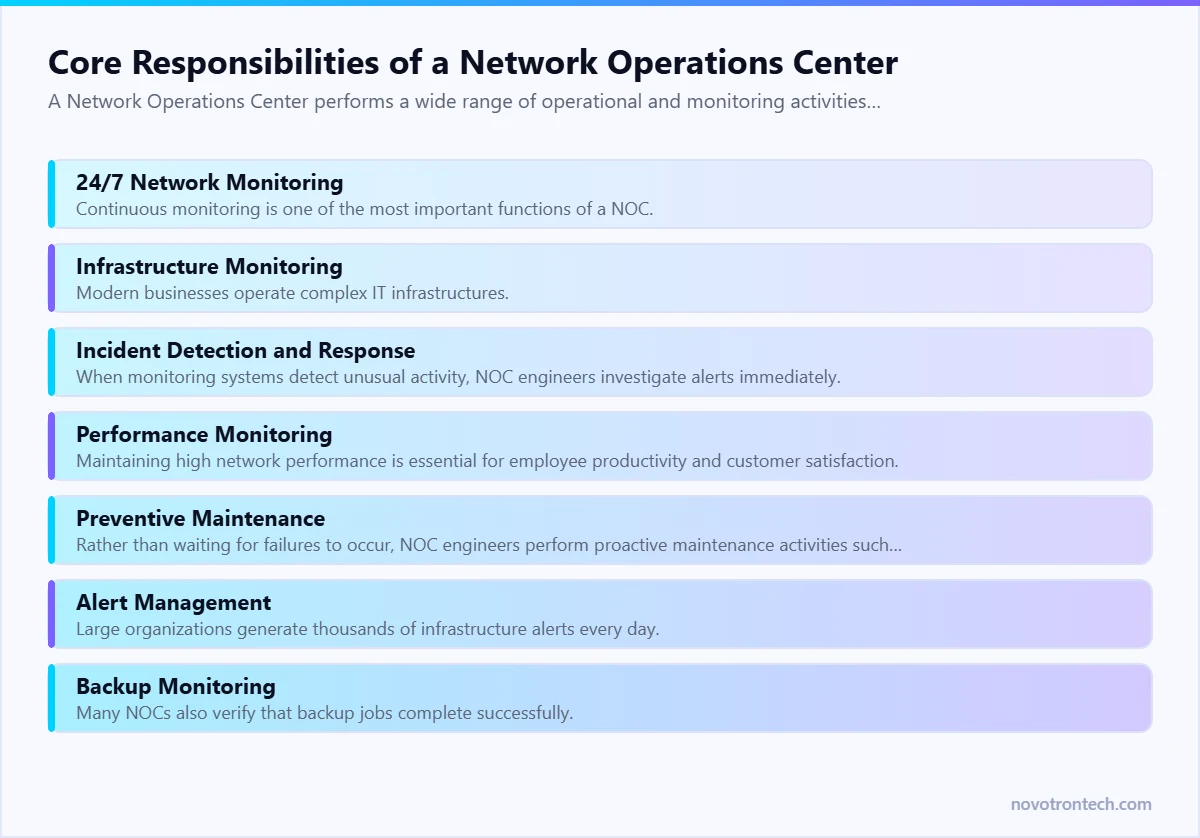
A Network Operations Center performs a wide range of operational and monitoring activities that help organizations maintain stable and reliable IT services.
24/7 Network Monitoring
Continuous monitoring is one of the most important functions of a NOC.
Engineers monitor network devices, cloud resources, applications, and servers around the clock to detect:
- Network outages
- High latency
- Device failures
- Internet disruptions
- Performance degradation
- Service interruptions
Early detection significantly reduces downtime.
Infrastructure Monitoring
Modern businesses operate complex IT infrastructures.
A NOC continuously monitors:
- Physical servers
- Virtual servers
- Cloud workloads
- Storage devices
- Network appliances
- Data center infrastructure
This helps identify hardware failures before they affect business operations.
Incident Detection and Response
When monitoring systems detect unusual activity, NOC engineers investigate alerts immediately.
Common incidents include:
- Server failures
- Network congestion
- Hardware faults
- ISP connectivity issues
- Storage failures
- Application outages
Rapid response minimizes service disruption and improves system availability.
Performance Monitoring
Maintaining high network performance is essential for employee productivity and customer satisfaction.
NOC teams analyze:
- Network speed
- Bandwidth usage
- Application response times
- Server performance
- Resource utilization
This helps identify bottlenecks before they impact users.
Preventive Maintenance
Rather than waiting for failures to occur, NOC engineers perform proactive maintenance activities such as:
- Software updates
- Patch management
- Firmware upgrades
- System health checks
- Configuration reviews
- Capacity planning
Preventive maintenance reduces the likelihood of unexpected outages.
Alert Management
Large organizations generate thousands of infrastructure alerts every day.
A NOC filters, prioritizes, and investigates these alerts to ensure critical issues receive immediate attention while reducing unnecessary noise.
Backup Monitoring
Many NOCs also verify that backup jobs complete successfully.
Failed backups are investigated immediately to ensure business-critical data remains protected and recoverable.
Key Components of a Network Operations Center
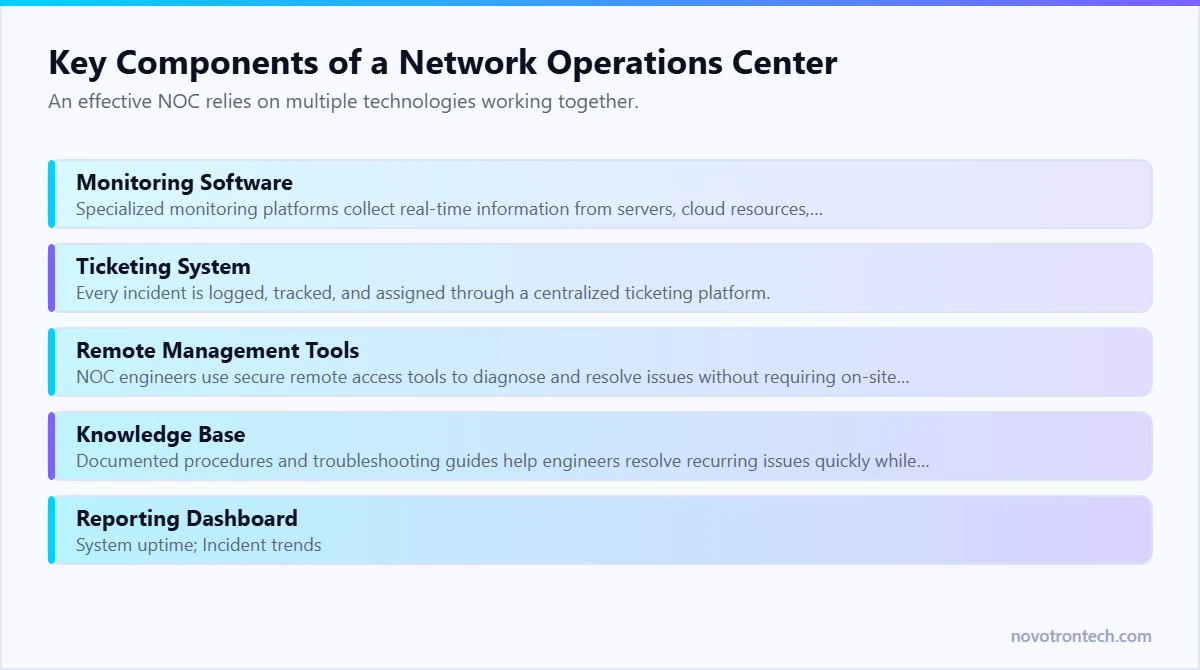
An effective NOC relies on multiple technologies working together.
Monitoring Software
Specialized monitoring platforms collect real-time information from servers, cloud resources, applications, and network devices.
These tools provide dashboards, alerts, reporting, and performance analytics.
Ticketing System
Every incident is logged, tracked, and assigned through a centralized ticketing platform.
This improves accountability and ensures issues are resolved within agreed service levels.
Remote Management Tools
NOC engineers use secure remote access tools to diagnose and resolve issues without requiring on-site visits.
This reduces response time and operational costs.
Knowledge Base
Documented procedures and troubleshooting guides help engineers resolve recurring issues quickly while maintaining consistent service quality.
Reporting Dashboard
Organizations receive regular reports covering:
- System uptime
- Incident trends
- Performance metrics
- Capacity utilization
- SLA compliance
- Infrastructure health
These reports help management make informed IT decisions.
Types of Network Operations Center Services
Different organizations require different levels of monitoring and support.
Remote NOC
A third-party provider remotely monitors and manages IT infrastructure from an off-site location.
This is a cost-effective option for small and medium-sized businesses.
Dedicated NOC
A dedicated NOC team focuses exclusively on one organization’s infrastructure.
Large enterprises often choose this model for greater customization and operational control.
In-House NOC
Some organizations build and operate their own internal Network Operations Center.
While this offers maximum control, it also requires significant investment in infrastructure, monitoring tools, and skilled personnel.
Managed NOC Services
Managed NOC services are delivered by specialized IT providers who handle monitoring, maintenance, incident response, and reporting.
This model allows businesses to access enterprise-grade monitoring without the expense of building an internal NOC.
Industries That Benefit from NOC Services
A Network Operations Center is valuable across nearly every industry that depends on reliable technology.
Industries that commonly use NOC services include:
- Financial Services
- Healthcare
- Manufacturing
- Retail & E-commerce
- Education
- Government
- Logistics & Supply Chain
- Telecommunications
- IT & Software Companies
- Professional Services
As digital transformation accelerates, continuous infrastructure monitoring has become a business necessity rather than an optional IT function.
Benefits of Network Operations Center (NOC) Services
Modern businesses cannot afford unexpected downtime, slow network performance, or infrastructure failures. Every minute of disruption can impact productivity, customer satisfaction, and revenue.
A Network Operations Center (NOC) helps businesses prevent these issues through proactive monitoring, rapid incident response, and continuous optimization.
Here are the biggest benefits of implementing NOC services.
24/7 Infrastructure Monitoring
Business operations no longer stop after office hours.
Employees work remotely, customers access online services around the clock, and cloud applications remain active 24/7.
A Network Operations Center continuously monitors:
- Servers
- Firewalls
- Switches
- Routers
- Cloud resources
- Applications
- Internet connectivity
- Virtual machines
Continuous monitoring enables businesses to detect problems before users experience service interruptions.
Reduced Downtime
Downtime is one of the biggest operational risks for any organization.
Whether caused by hardware failures, network congestion, software issues, or ISP outages, downtime can significantly affect productivity.
A NOC identifies and resolves many issues before they become major incidents, helping organizations maintain maximum uptime.
Faster Incident Response
The sooner a problem is detected, the faster it can be resolved.
NOC engineers receive automated alerts when abnormal behavior is detected and immediately begin troubleshooting.
This reduces:
- Mean Time to Detect (MTTD)
- Mean Time to Respond (MTTR)
Faster response means less disruption for employees and customers.
Improved Network Performance
Network performance directly impacts business operations.
A NOC continuously analyzes:
- Bandwidth utilization
- Device health
- Application response times
- Latency
- Packet loss
- Resource consumption
Performance optimization helps businesses deliver a better user experience while reducing operational bottlenecks.
Better Business Continuity
Unexpected failures should not stop business operations.
By continuously monitoring infrastructure and supporting rapid recovery processes, NOC services strengthen business continuity and reduce operational risk.
Cost Savings
Building an in-house Network Operations Center requires:
- Skilled engineers
- Monitoring software
- Hardware
- Infrastructure
- 24/7 staffing
- Ongoing training
Managed NOC services provide enterprise-level monitoring without the cost and complexity of maintaining a dedicated internal team.
Improved Scalability
As businesses grow, their IT environments become more complex.
Managed NOC services scale easily to support:
- Additional offices
- Cloud workloads
- Remote employees
- New servers
- Business applications
- Hybrid infrastructure
Organizations can expand operations without significantly increasing IT management complexity.
Network Operations Center (NOC) vs Security Operations Center (SOC)
Many businesses confuse a NOC with a SOC because both monitor IT environments.
However, they serve different purposes.
| Feature | Network Operations Center (NOC) | Security Operations Center (SOC) |
|---|---|---|
| Primary Goal | Ensure IT systems remain operational | Detect and respond to cyber threats |
| Focus | Infrastructure availability | Security monitoring |
| Monitors | Networks, servers, cloud, applications | Security events, threats, attacks |
| Typical Incidents | Hardware failures, outages, performance issues | Malware, ransomware, phishing, intrusions |
| Main Objective | Maximize uptime | Protect business assets |
The two functions complement each other.
A NOC keeps systems running.
A SOC keeps systems secure.
Many modern organizations combine both services for complete IT operations and cyber security management.
Why Every Business Needs a Network Operations Center
Technology downtime affects organizations of every size.
Whether you’re a startup or a large enterprise, uninterrupted access to business systems is essential.
Businesses benefit from a NOC because it helps:
- Monitor business-critical infrastructure 24/7
- Detect issues before users report them
- Reduce downtime
- Improve network reliability
- Increase employee productivity
- Improve customer experience
- Support hybrid work environments
- Monitor cloud infrastructure
- Improve operational efficiency
As organizations adopt digital transformation initiatives, proactive infrastructure monitoring becomes increasingly important.
Common IT Challenges Solved by a NOC
A Network Operations Center helps businesses solve many day-to-day IT challenges.
Server Outages
Unexpected server failures can interrupt business applications and internal operations.
NOC engineers monitor server health continuously and respond immediately when issues arise.
Network Congestion
High bandwidth usage or misconfigured devices can slow business applications.
Continuous monitoring helps identify bottlenecks before they affect users.
Internet Connectivity Issues
Businesses rely heavily on stable internet connectivity.
A NOC detects ISP outages, packet loss, and connectivity issues quickly, reducing business disruption.
Hardware Failures
Storage systems, routers, switches, and servers all experience hardware failures over time.
Predictive monitoring helps organizations replace failing components before complete outages occur.
Capacity Planning
Growing businesses often experience resource shortages.
NOC teams monitor CPU, memory, storage, and bandwidth trends to help organizations plan infrastructure upgrades before performance degrades.
Application Performance Problems
Slow business applications reduce productivity.
NOC engineers identify application bottlenecks and infrastructure issues affecting performance.
Best Practices for an Effective Network Operations Center
Organizations can maximize the value of their NOC by following proven operational practices.
Implement Proactive Monitoring
Do not wait for users to report issues.
Continuous monitoring allows engineers to identify and resolve problems before they impact business operations.
Define Clear Escalation Procedures
Every incident should follow a documented escalation process.
Critical issues must reach the appropriate technical teams immediately to reduce response times.
Automate Routine Tasks
Automation improves efficiency by handling repetitive operational tasks such as:
- Alert generation
- System health checks
- Backup verification
- Report generation
- Performance monitoring
This allows engineers to focus on complex technical issues.
Review Performance Reports Regularly
Regular reporting helps organizations identify trends and improve long-term infrastructure planning.
Key metrics include:
- Uptime
- Availability
- Incident frequency
- Capacity utilization
- SLA compliance
- Response times
Integrate NOC with Cyber Security
Infrastructure monitoring and cyber security should work together.
Many organizations integrate their NOC with:
- Security Operations Center (SOC)
- SIEM platforms
- Endpoint Security
- Identity & Access Management (IAM)
- Vulnerability Management
This provides better visibility across the entire IT environment.
Why Businesses Choose Novotron for Managed NOC Services
Managing modern IT infrastructure requires continuous monitoring, experienced engineers, and proactive operational support.
Novotron delivers enterprise-grade Managed NOC Services designed to improve uptime, optimize performance, and reduce operational risks.
Our Network Operations Center capabilities include:
- 24/7 Infrastructure Monitoring
- Network Performance Monitoring
- Cloud Infrastructure Monitoring
- Server Monitoring
- Router & Switch Monitoring
- Firewall Monitoring
- Application Monitoring
- Remote Infrastructure Management
- Incident Detection & Response
- Preventive Maintenance
- Backup Monitoring
- Performance Reporting
- Capacity Planning
- Managed IT Services
- IT Infrastructure Management
By combining proactive monitoring, automation, and experienced IT professionals, Novotron helps businesses maintain reliable, secure, and high-performing IT environments while reducing downtime and improving operational efficiency.
Related: managed IT services in Noida — complete guide & pricing · in-house vs managed IT support, honestly compared · our managed IT services.
Frequently Asked Questions
What does a network operations centre (NOC) actually do?
A NOC is the team and facility that continuously monitors an organisation’s network, servers, applications and infrastructure for availability and performance. It detects faults, triages alerts, performs first-line remediation, coordinates vendors, and escalates anything it cannot resolve — with the goal of catching problems before users notice them.
What is the difference between a NOC and a SOC?
A NOC protects availability and performance; a SOC protects against security threats. A NOC asks “is it up and running well?” A SOC asks “is someone attacking it?” Mature operations run both, and the two share alerts because an outage and an intrusion often look identical in the first ten minutes.
Does my business need a NOC, or is monitoring software enough?
Monitoring software generates alerts; a NOC acts on them. If nobody is watching the dashboard at 3 a.m., the alert is only a record of when the outage started. Businesses with revenue-critical systems, multi-site infrastructure or 24/7 operations need people behind the tooling — either in-house or through an outsourced NOC.
Should we build an in-house NOC or outsource it?
True 24/7 in-house coverage needs at least five to six engineers to staff the rota sustainably, plus tooling. For most businesses under roughly 500 users that is far more expensive than an outsourced NOC, which spreads specialist engineers and monitoring platforms across many clients. In-house becomes viable at scale, or where regulation demands it.
What should a NOC service level agreement include?
Detection-to-acknowledgement time, acknowledgement-to-first-action time, resolution targets by severity, agreed escalation contacts, a monthly report of actual performance against those targets, and a defined maintenance window policy. An SLA without published actuals is a marketing document.
How does NOC monitoring reduce downtime?
Most outages announce themselves before they happen — disks throw SMART errors, memory usage climbs, backups start failing, certificates approach expiry, UPS batteries degrade. Continuous infrastructure monitoring with someone acting on the signals converts a large share of would-be outages into scheduled maintenance.