
IT AMC quotes in India are hard to compare because almost nobody quotes the same thing twice. One vendor prices per device per year, another per device per month, a third quotes a flat annual figure for “the whole office” — and the cheapest of the three usually excludes the parts that break.
The short answer: in 2026, a non-comprehensive IT AMC in India typically costs ₹1,200–₹3,500 per desktop per year, and a comprehensive AMC ₹2,500–₹6,500 per desktop per year. Remote-only tiers start near ₹800 per device per year; laptops and servers cost more. A 10-system small office usually lands between ₹8,000 and ₹25,000 a year, and a 25-system office between ₹25,000 and ₹60,000. What moves your number is coverage type, device age, response SLA and how many devices you are putting on one contract.
This guide breaks down where those numbers come from, what a quote should contain, what is routinely excluded, and how to negotiate without stripping out the parts you actually need.
IT AMC Cost in India: 2026 at a Glance
Indicative market ranges for budgeting. Actual quotes vary with location, hardware brand and age, and agreed service levels.
| Item | Non-comprehensive (labour only) | Comprehensive (labour + parts) |
|---|---|---|
| Desktop, per year | ₹1,200 – ₹3,500 | ₹2,500 – ₹6,500 |
| Laptop, per year | ₹2,000 – ₹4,500 | ₹5,000 – ₹9,000 |
| Entry-level server, per year | ₹8,000 – ₹18,000 | ₹15,000 – ₹35,000 |
| Network device (switch, firewall, AP), per year | ₹2,000 – ₹6,000 | ₹5,000 – ₹15,000 |
| Printer / MFP, per year | ₹1,500 – ₹4,000 | ₹3,500 – ₹8,000 |
| Remote-support-only tier, per device per year | from around ₹800 | |
By office size, the all-in annual figures most Delhi NCR businesses see:
- Small office, 5–10 systems — roughly ₹8,000 – ₹25,000 per year
- Medium office, 10–25 systems — roughly ₹25,000 – ₹60,000 per year
- 25–100 systems — usually moves to per-device pricing with volume discounts of 15–25%
- 100+ systems — almost always custom-scoped, and usually the point at which managed IT becomes the better commercial fit
What Actually Drives an IT AMC Price
- Coverage type. Comprehensive versus non-comprehensive is the single biggest lever — typically a 2x difference, because the vendor is absorbing parts risk.
- Device age and warranty status. A fleet averaging four years old costs materially more to cover than one averaging eighteen months, and some vendors will refuse comprehensive cover on hardware past a certain age.
- Response SLA. Next-business-day on-site is the cheap tier. Two-hour on-site response roughly doubles it, because the vendor has to hold local engineer capacity for you.
- Service hours. Business hours versus 24×7 changes the staffing model entirely, and therefore the price.
- Visit frequency. Quarterly preventive visits versus monthly or fortnightly. Preventive maintenance is where AMCs earn their value, so this is a poor place to economise.
- Device count. Volume discounts of 15–25% typically start around 20 devices, because travel and coordination costs amortise.
- Contract term. Annual contracts usually price 10–15% below equivalent monthly billing, and two- to three-year terms often attract a further 10–15%.
- Site count. Three offices across NCR cost more than one office with the same total device count. Travel is a real cost.
Comprehensive vs Non-Comprehensive: The Cost Difference That Matters
A non-comprehensive AMC covers the engineer’s time. Parts are billed separately when something fails. A comprehensive AMC folds parts into the fixed fee.
The arithmetic is straightforward. On a 40-device fleet, non-comprehensive at ₹2,200 per device is ₹88,000 a year. Comprehensive at ₹4,500 per device is ₹1.8 lakh. The premium is ₹92,000 — so comprehensive pays for itself if you expect roughly ₹92,000 of parts failures across 40 devices in a year.
On hardware under three years old, you almost certainly will not hit that. On a five-year-old fleet of laptops, where hinges, batteries, keyboards and SSDs fail steadily, you very likely will. That, rather than the headline rate, is the decision.
Rule of thumb: non-comprehensive for fleets under three years old; comprehensive for ageing hardware, laptop-heavy teams, and any finance function that values budget certainty over the lowest headline number.
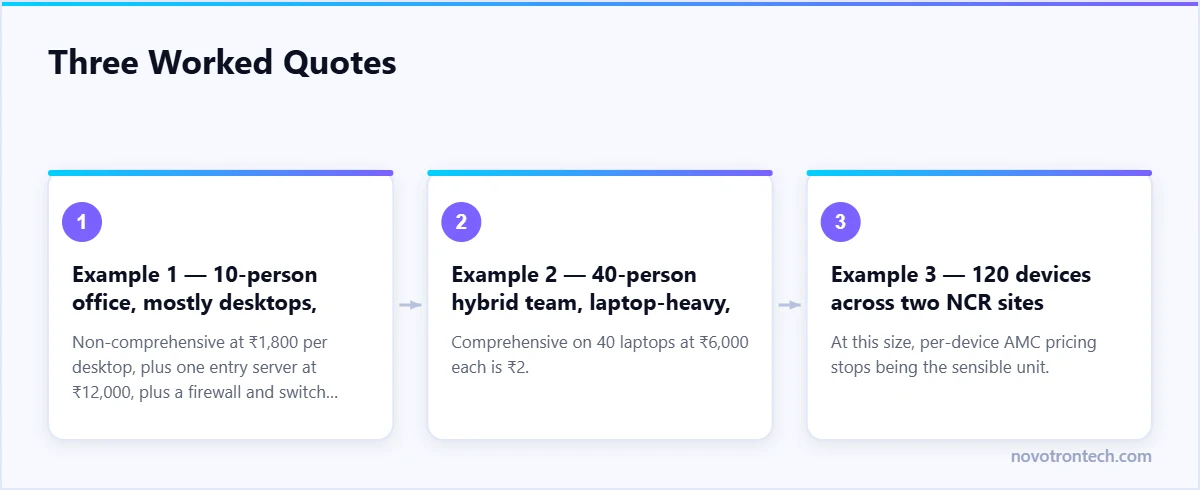
Three Worked Quotes
Example 1 — 10-person office, mostly desktops, hardware under 2 years old
Non-comprehensive at ₹1,800 per desktop, plus one entry server at ₹12,000, plus a firewall and switch at ₹4,000 combined. Annual total roughly ₹34,000, with quarterly preventive visits and next-business-day on-site response. Parts billed at cost when needed.
Example 2 — 40-person hybrid team, laptop-heavy, hardware 3–4 years old
Comprehensive on 40 laptops at ₹6,000 each is ₹2.4 lakh, plus two servers at ₹22,000 each and network devices at ₹15,000 — around ₹2.99 lakh before a 15% volume discount, landing near ₹2.55 lakh a year with four-hour on-site response and monthly preventive visits.
Example 3 — 120 devices across two NCR sites
At this size, per-device AMC pricing stops being the sensible unit. Quotes typically arrive at ₹5–8 lakh a year for comprehensive cover — at which point you should also price managed IT services, because for a similar or modestly higher figure you get monitoring, patching, security and a service desk rather than repair alone. Our IT AMC vs managed IT services comparison sets out where the crossover happens.
What an IT AMC Includes
- Corrective maintenance — diagnosis and repair of hardware and OS faults
- Preventive maintenance visits on an agreed cycle
- Remote and on-site technical support within agreed hours
- Basic OS and driver troubleshooting, reimaging and reinstallation
- Printer and peripheral servicing, where in scope
- Spare parts, in comprehensive contracts only
- Coordination with OEM warranty where devices are still covered
What an IT AMC Almost Never Includes
- 24×7 monitoring of servers, network or backups — see infrastructure monitoring
- Patch management on a defined, reported cycle
- Cyber security — endpoint protection, MFA, identity administration, or SOC monitoring
- Cloud administration — Microsoft 365, Azure, AWS or Google Workspace tenants
- Backup ownership and restore testing
- Consumables — toner, cartridges, batteries in many contracts
- Physical damage, liquid damage, power surges and theft
- Software licences and application-level support
- A service desk with ticketing and SLA reporting — see global service desk
None of this is a vendor being evasive. It is simply outside what an AMC is. It becomes expensive when a business assumes otherwise.
Hidden Costs to Check Before You Sign
- Per-visit charges beyond an included quota. Some contracts cap included visits and bill the rest.
- Out-of-hours call-out rates. Ask what a Sunday evening failure costs.
- Parts markup in non-comprehensive contracts. “At cost” should mean at cost — ask to see supplier invoices.
- Excluded components. Batteries, screens and motherboards are commonly carved out of “comprehensive” cover. Get the exclusion list in writing.
- Device-age cut-offs. Cover that silently lapses on hardware past five years.
- Travel charges for sites outside a defined radius.
- Escalation and replacement timelines. A part covered but sourced in three weeks is not covered in any way that helps you.
GST and Contract Terms
IT AMC services attract GST at the standard services rate, so compare quotes on the same basis — some vendors quote inclusive, others exclusive, and an 18% difference is easy to miss. Check the payment schedule too: annual advance typically buys a better rate than quarterly billing, but ties up cash and reduces your leverage if service quality slips. A mid-point many businesses land on is half-yearly billing with a defined service-credit clause.
How to Negotiate an IT AMC
- Send one scope to every vendor. A device list with make, model, age and location. Comparable inputs produce comparable quotes.
- Split the fleet by age. Comprehensive on the old hardware, non-comprehensive on the new. Most vendors will do this and it is usually the single largest saving available.
- Trade term for rate. A two-year commitment reliably buys 10–15%, and is low risk if you negotiate an exit clause for sustained SLA failure.
- Buy the SLA you need, not the best one offered. Two-hour on-site for the finance server, next-business-day for the marketing team’s desktops.
- Ask for last quarter’s actual response figures. Vendors who measure will share. Vendors who do not, will not — and that is your answer.
- Get service credits in writing. An SLA with no consequence is a sentence, not a commitment.
- Price the managed alternative at the same time. Even if you renew the AMC, you will negotiate better knowing what the next tier costs.
When an AMC Stops Being the Cheaper Option
An AMC is genuinely economical when your IT is static, on-premise and low-risk. It stops being economical the moment its exclusions start costing you money — and those costs rarely appear on the AMC invoice. They appear as an unpatched machine that got encrypted, a backup nobody tested, a departed employee whose account still worked, or four hours of a 40-person team unable to work.
The signal to re-price is behavioural, not financial: when your team starts calling the AMC vendor for things the AMC does not cover, the contract has already stopped matching the business. Our guides on in-house versus outsourced IT support and managed IT services pricing in Noida cover what comes next.
Getting an Accurate Number for Your Business
Any AMC quote produced without an equipment list is a guess. The useful first step is a short infrastructure audit — device inventory, age profile, warranty status, server and network estate, and where the actual risk sits. Novotron runs that audit for businesses across Noida and Delhi NCR from its Sector 135 office, and will price both an AMC and a managed IT option so the comparison is honest. Talk to our team, or read how to choose an IT company in Noida first.
Frequently Asked Questions
How much does an IT AMC cost per computer in India?
In 2026, a non-comprehensive AMC typically costs ₹1,200–₹3,500 per desktop per year and a comprehensive AMC ₹2,500–₹6,500 per desktop per year. Laptops run higher — roughly ₹2,000–₹4,500 non-comprehensive and ₹5,000–₹9,000 comprehensive — because their parts cost more and fail more often. Remote-support-only tiers start near ₹800 per device per year.
What is the difference between comprehensive and non-comprehensive AMC?
A non-comprehensive AMC covers labour only; spare parts are billed separately when something fails. A comprehensive AMC includes both labour and parts in one fixed annual fee. Comprehensive typically costs about twice as much and makes sense on hardware older than three years or on laptop-heavy fleets.
How much does an IT AMC cost for a 10-person office?
A small office running five to ten systems usually pays between ₹8,000 and ₹25,000 a year, depending on whether cover is comprehensive, how old the hardware is, and what response SLA is agreed. Adding a server typically adds ₹8,000–₹35,000 a year on its own.
Does an IT AMC include cyber security?
No. A standard AMC covers hardware and software faults. It does not include patch management, endpoint protection, MFA, identity administration, monitoring or incident response. Those sit inside managed IT or dedicated security services and must be contracted separately.
Is GST charged on IT AMC services?
Yes, IT AMC is a taxable service and attracts GST at the standard services rate. Always confirm whether a quote is inclusive or exclusive of GST before comparing vendors, because the difference is large enough to reverse a ranking.
Can I get an IT AMC for laptops only?
Yes. Most providers will scope an AMC to any device category — laptops only, servers only, printers only, or a mix. Laptop-only contracts are common for hybrid teams, though they are priced higher per device than desktops because failure rates and part costs are higher.
How long does an IT AMC contract usually run?
One year is standard. Three-month contracts are available from some providers, and two- to three-year terms typically attract a 10–15% discount. Whatever the term, negotiate an exit clause tied to sustained SLA failure rather than relying on goodwill.
Is managed IT better value than an AMC?
For businesses whose staff work on laptops, use cloud applications, or handle customer data, usually yes — because managed IT includes monitoring, patching, security and a service desk that an AMC does not. For a small, static, on-premise office with low downtime risk, an AMC remains the cheaper and entirely reasonable choice.
Read next: how to choose an IT company in Noida, plus the 2026 price bands for the best IT company in Noida for startups and SMEs.