Passwords alone are no longer enough to protect business systems from cyber threats. Multi-Factor Authentication (MFA) adds an extra layer of security by requiring multiple forms of identity verification before granting access. Learn how MFA helps businesses reduce cyber risks, prevent unauthorized access, and strengthen overall security.
Cyber threats have become increasingly sophisticated in recent years. While businesses invest heavily in firewalls, endpoint security, and cloud protection, one of the most common causes of security breaches remains compromised user credentials.
Attackers use phishing emails, credential stuffing, brute-force attacks, and social engineering techniques to steal usernames and passwords. Once login credentials are compromised, cybercriminals can gain unauthorized access to business applications, cloud platforms, financial systems, and sensitive customer data.
According to multiple industry security reports, stolen or weak credentials continue to be one of the leading causes of data breaches worldwide. This makes identity protection a critical part of every organization’s cyber security strategy.
This is where Multi-Factor Authentication (MFA) plays a vital role.
Instead of relying solely on a password, MFA requires users to verify their identity using two or more authentication factors before access is granted. Even if a password is stolen, attackers are unlikely to gain access without the additional verification step.
For businesses embracing remote work, cloud computing, and digital transformation, MFA has become a fundamental security requirement rather than an optional feature.
In this guide, we’ll explore how Multi-Factor Authentication works, why it matters, the different authentication methods available, and how organizations can implement MFA to improve their overall security posture.
What Is Multi-Factor Authentication (MFA)?
Multi-Factor Authentication (MFA) is a security mechanism that requires users to provide two or more independent forms of verification before they can access an account, application, or system.
Traditional authentication relies only on a username and password. While passwords are important, they can be guessed, stolen, reused, or exposed in data breaches.
MFA significantly reduces this risk by requiring additional proof of identity.
Authentication factors generally fall into three categories:
1. Something You Know
This refers to information only the user should know, such as:
- Passwords
- PINs
- Security questions
2. Something You Have
This refers to a physical device or token possessed by the user, including:
- Mobile phones
- Authentication apps
- Hardware security keys
- One-Time Password (OTP) tokens
- Smart cards
3. Something You Are
This involves biometric verification, such as:
- Fingerprint recognition
- Facial recognition
- Iris scanning
- Voice recognition
Modern MFA solutions combine two or more of these factors to verify user identity before granting access.
Why Passwords Alone Are No Longer Enough
For decades, passwords served as the primary method of authentication. However, the modern threat landscape has exposed significant weaknesses in password-only security.
Common password-related risks include:
- Weak passwords
- Reused passwords across multiple accounts
- Password sharing
- Credential theft
- Phishing attacks
- Brute-force attacks
- Password database leaks
Even organizations with strong password policies remain vulnerable if user credentials are stolen through phishing or malware.
Cybercriminals often purchase leaked credentials from underground marketplaces and attempt to use them against multiple business applications.
Without additional verification, compromised credentials can provide attackers with unrestricted access to sensitive business systems.
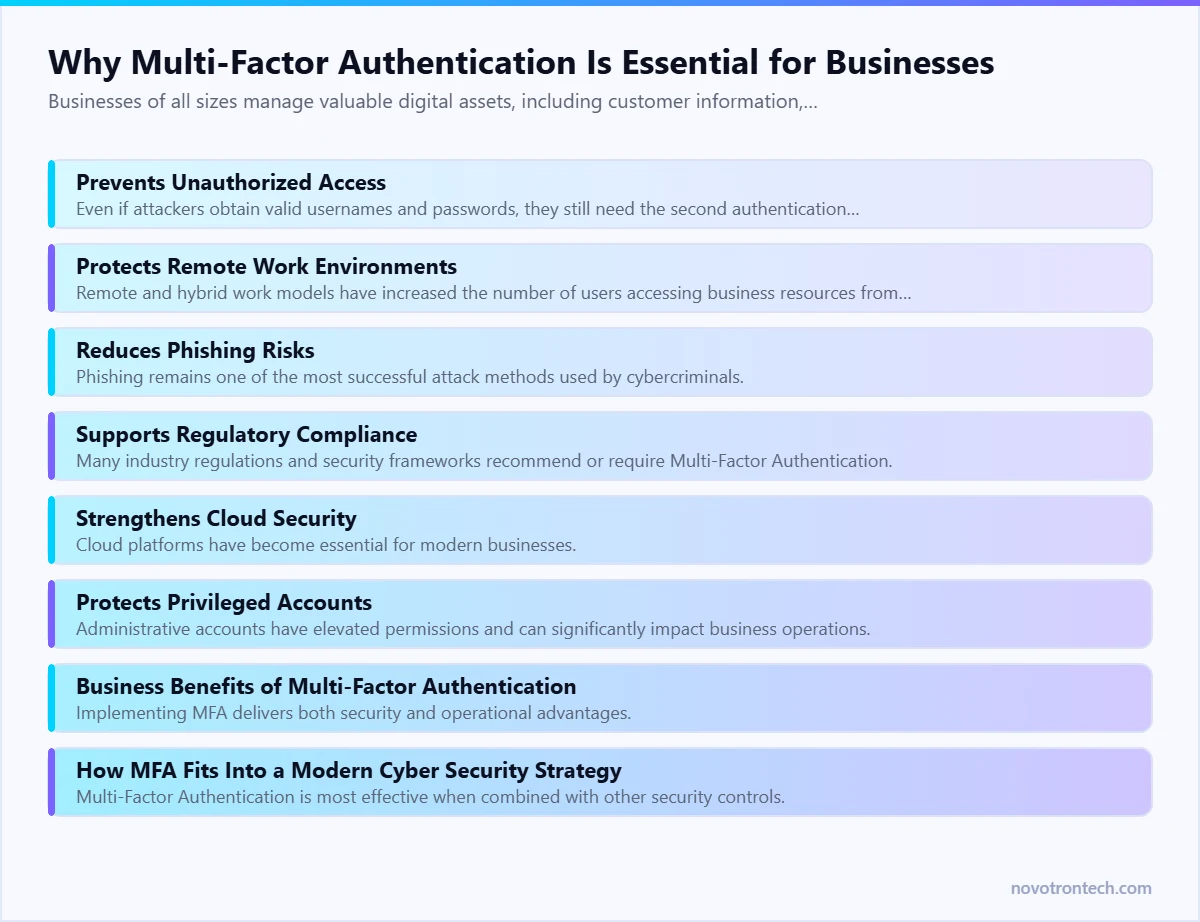
Why Multi-Factor Authentication Is Essential for Businesses
Businesses of all sizes manage valuable digital assets, including customer information, financial records, intellectual property, and confidential communications.
Protecting these assets requires stronger identity verification than passwords alone.
Here are the key reasons every business should implement MFA.
1. Prevents Unauthorized Access
Even if attackers obtain valid usernames and passwords, they still need the second authentication factor to access business systems.
This dramatically reduces the likelihood of unauthorized access.
2. Protects Remote Work Environments
Remote and hybrid work models have increased the number of users accessing business resources from outside traditional office networks.
MFA ensures that remote employees can securely access:
- Cloud applications
- VPN connections
- Email platforms
- Collaboration tools
- Business systems
This reduces the risks associated with remote access.
3. Reduces Phishing Risks
Phishing remains one of the most successful attack methods used by cybercriminals.
Although MFA cannot eliminate phishing entirely, it significantly limits the damage caused by stolen credentials.
Even if employees unknowingly reveal their passwords, attackers still require the second verification factor.
4. Supports Regulatory Compliance
Many industry regulations and security frameworks recommend or require Multi-Factor Authentication.
Examples include:
- ISO 27001
- PCI DSS
- HIPAA
- GDPR
- NIST Cybersecurity Framework
Implementing MFA helps businesses strengthen compliance while improving overall security.
5. Strengthens Cloud Security
Cloud platforms have become essential for modern businesses.
Applications such as:
- Microsoft 365
- Google Workspace
- CRM platforms
- ERP systems
- Cloud storage solutions
contain highly sensitive business information.
MFA helps secure cloud environments by preventing unauthorized account access.
6. Protects Privileged Accounts
Administrative accounts have elevated permissions and can significantly impact business operations.
If these accounts are compromised, attackers may gain complete control over business systems.
Organizations should require MFA for:
- IT administrators
- Cloud administrators
- Finance teams
- HR systems
- Executive leadership accounts
Protecting privileged accounts should always be a security priority.
Business Benefits of Multi-Factor Authentication
Implementing MFA delivers both security and operational advantages.
Improved Cyber Security
MFA creates multiple layers of defense against credential-based attacks.
Reduced Risk of Data Breaches
Additional authentication factors make unauthorized access significantly more difficult.
Enhanced Customer Trust
Businesses that implement strong security controls demonstrate their commitment to protecting customer information.
Better Business Continuity
Preventing unauthorized access reduces the likelihood of security incidents that disrupt operations.
Supports Zero Trust Security
Modern Zero Trust security models assume that no user or device should be trusted automatically.
MFA plays a central role in verifying every access request before permissions are granted.
How MFA Fits Into a Modern Cyber Security Strategy
Multi-Factor Authentication is most effective when combined with other security controls.
A comprehensive business security strategy should include:
- Endpoint Security
- Network Security
- Security Operations Center (SOC)
- Vulnerability Assessment and Penetration Testing (VAPT)
- Cloud Security
- Identity and Access Management (IAM)
- Employee Security Awareness Training
Rather than replacing these controls, MFA strengthens them by protecting one of the most common attack vectors—user identities.
Related: what VAPT & SOC monitoring actually cost in Noida · 24/7 SOC support services · how to choose an IT partner in Noida.
Frequently Asked Questions
What is multi-factor authentication?
Multi-factor authentication (MFA) requires two or more independent proofs of identity before granting access — typically something you know (a password), something you have (a phone, token or passkey), and sometimes something you are (a fingerprint or face). Because an attacker who steals a password still lacks the second factor, MFA blocks the overwhelming majority of credential-based attacks.
Is MFA the same as two-factor authentication?
Two-factor authentication (2FA) is MFA with exactly two factors. MFA is the broader term and can include three or more. In practice most business deployments are 2FA, and the terms are used interchangeably.
Which MFA method is most secure?
Phishing-resistant methods rank highest: passkeys and FIDO2 hardware security keys, because they are cryptographically bound to the real site and cannot be replayed on a fake one. Authenticator apps with number matching come next. SMS one-time codes are the weakest common method — still far better than a password alone, but vulnerable to SIM swap and interception.
Can MFA be bypassed?
Yes, which is why method choice matters. Attackers use MFA-fatigue push bombing, adversary-in-the-middle phishing kits that relay session tokens, and SIM swap against SMS codes. Number matching, conditional access policies, session-token protection and phishing-resistant factors close most of these paths. Pair MFA with identity and access management rather than treating it as a standalone control.
Where should a business roll out MFA first?
Administrative and privileged accounts first, then email and the identity provider itself, then VPN and remote access, then finance and HR systems, then everything else. Privileged accounts are the highest-value target and the smallest population, which makes them the fastest meaningful win.
Does MFA slow employees down?
Modern deployments barely register. Conditional access can skip prompts on managed devices in trusted locations and challenge only on risk signals — new device, unusual country, impossible travel. Deployed well, most staff authenticate once a day; deployed badly, MFA prompts every hour and people start approving them without looking, which is exactly how push-fatigue attacks succeed.
Not All MFA Is Equally Strong
Enabling MFA is not a single decision — the factor you choose determines how much protection you actually get.
- SMS one-time passwords. Better than nothing, and far better than passwords alone. Vulnerable to SIM swap and to real-time phishing that relays the code. Acceptable as a starting point, not as an end state for administrators.
- Authenticator app codes (TOTP). Stronger, and free. Still phishable, because a convincing fake login page can capture and replay the code within its validity window.
- Push notifications with number matching. Removes blind approval and defeats push-fatigue attacks, where an attacker spams prompts until someone taps accept.
- Hardware security keys and passkeys (FIDO2/WebAuthn). Cryptographically bound to the real domain, so a phishing site cannot use them. The strongest widely available option, and the right choice for administrators and finance staff.
A workable policy for most businesses: passkeys or hardware keys for every privileged and finance account, authenticator apps with number matching for everyone else, and SMS only as a temporary fallback during enrolment.
The Gaps That Let Attackers Around MFA
Most MFA failures are not clever attacks on the second factor. They are places where the second factor was never applied.
- Legacy authentication protocols left enabled — older mail protocols bypass modern MFA entirely. Disable them.
- Service and shared accounts excluded “temporarily” and never revisited. These are usually the highest-privilege accounts in the estate.
- Session tokens. Stealing a valid session cookie skips authentication altogether. Shorter session lifetimes and device compliance checks reduce the window.
- Self-service enrolment without verification, letting an attacker with a stolen password register their own device as the second factor.
- Helpdesk reset procedures with no identity verification — a well-rehearsed phone call is still one of the most effective routes past MFA.
- Coverage gaps on VPN, RDP, cloud consoles and third-party SaaS, where MFA is often enabled on email and forgotten elsewhere.
Rolling MFA Out Without a Helpdesk Crisis
- Start with administrators. Highest risk, smallest group, most technically comfortable.
- Then finance and anyone who can move money — the group targeted by business email compromise.
- Communicate before enforcing, with a two-week enrolment window and clear instructions covering the case where someone has no company phone.
- Provide an alternative for staff who will not use a personal device: hardware keys are inexpensive and remove the objection entirely.
- Enforce with conditional access, so trusted managed devices on known networks prompt less often and risky sign-ins prompt more. Fewer unnecessary prompts means fewer blind approvals.
- Disable legacy protocols on the same day, or the rollout leaves the main bypass open.
MFA is the highest-return control available to most businesses, but it protects the front door only. Pair it with identity and access management for lifecycle and privilege control, endpoint security for the device, and Zero Trust principles so a valid login does not grant access to everything.